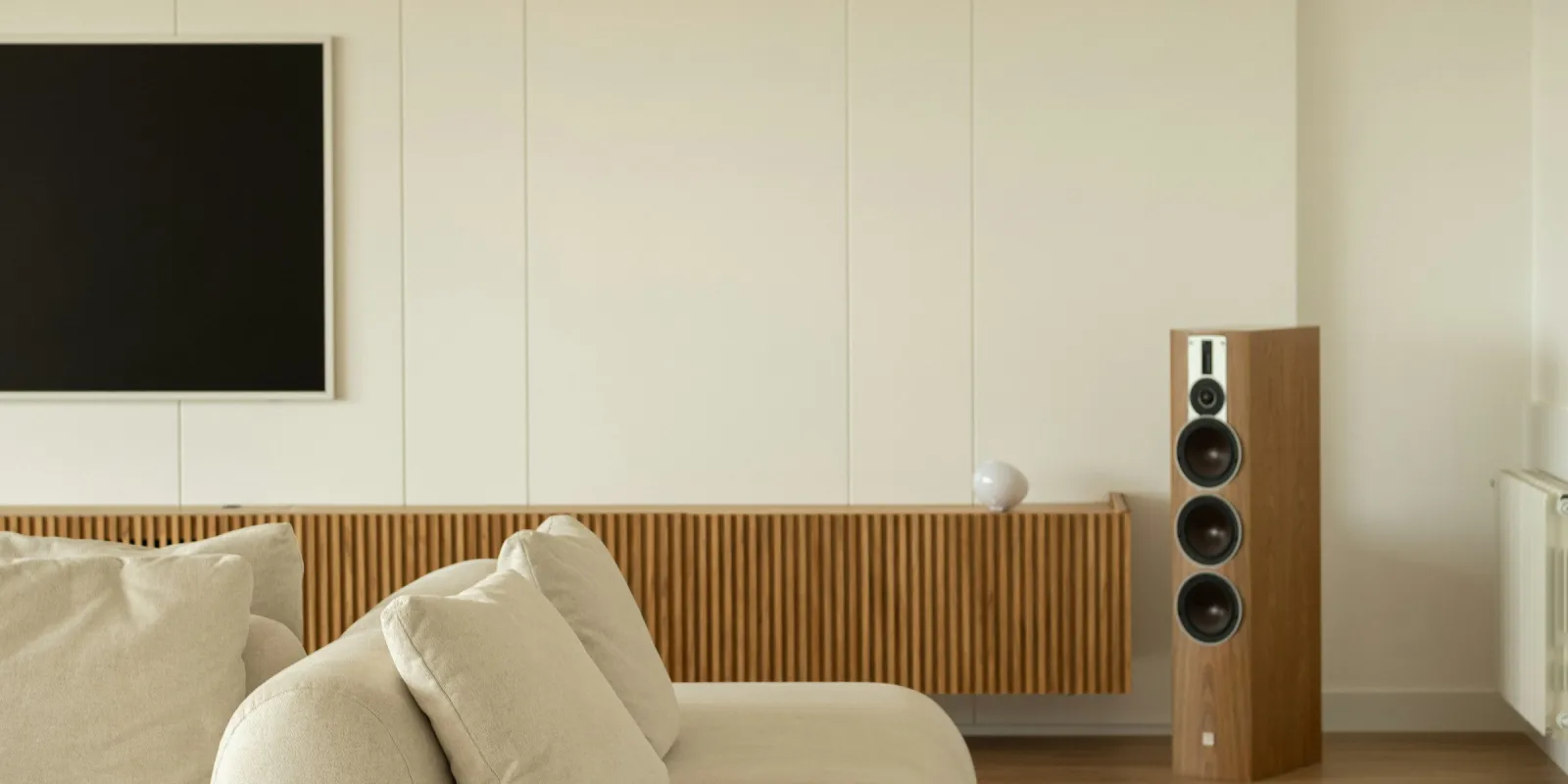
The best tower speaker for you depends less on brand and more on three things: how big your room is, what amplifier you will drive it with, and how close to the wall it has to sit. Get those right and almost any of the picks below can sound excellent. Get them wrong and even an expensive pair can sound boomy, thin or strained.
This guide gives you eight research-based picks, each chosen for a specific job, and then explains how to choose in plain English. We built the shortlist from manufacturer specifications and documentation, and we flag where those specs are incomplete or measured differently from brand to brand. We have not run our own listening tests, and we say so rather than invent impressions.
If you already know your room size and budget, the Speaker Match Finder will narrow the list for you in under a minute.
How we researched this: This guide is based on manufacturer specifications, owner documentation, published third-party measurements and professional reviews. We have not hands-on tested these speakers unless a section says so. Our methodology
Best overall: Polk Audio Signature Elite ES60
The ES60 earns the top spot because it is the most forgiving all-rounder on paper. Three 6.5-inch woofers give it plenty of cone area for bass and output, and Polk rates sensitivity at 90 dB (2.83V/1m), which is comfortably above average. In practice that means a typical AV receiver or stereo amplifier will drive it to loud levels without working hard. Polk rates bass extension to 32 Hz, although it does not publish a tolerance, so treat that figure as a guide rather than a measurement you can compare directly with other brands.
It suits medium-to-large rooms and people who split their time between music and movies. Two caveats: the cabinet is 15.7 inches deep, so it needs real floor space, and Polk publishes only “4 and 8 ohm compatible” rather than a nominal impedance figure. Polk also does not state in its spec table whether it is a 2-way or 3-way design. None of that is a red flag, but it is worth knowing if you like to match amplifiers precisely. It is sold individually, so budget for two. Check current price on Amazon.
Polk Audio Signature Elite ES60
Three 6.5 in. woofers, 90 dB sensitivity and 32 Hz rated extension make this a versatile, easy-to-drive tower for music and movies in medium to large rooms.
- DesignPassive, 4 drivers (3 woofers)
- Drivers1 in. Terylene dome tweeter, 3x 6.5 in. mica-reinforced polypropylene woofers
- Frequency response32 Hz–40 kHz
- Sensitivity90 dB (2.83V)
- Impedance4–8 Ω amp compatible
- Amp power50-300 W per channel
- Dimensions44.5 × 8.5 × 15.7 in. (H×W×D)
- Weight52 lb
Advantages
- 90 dB (2.83V) sensitivity plays loud on modest power
- Three woofers for bass weight and output
- Widely available in the US
Limitations
- Deep 15.7 in. cabinet needs floor space
- Frequency response tolerance not published
- Sold individually
Best budget: Polk Audio Monitor XT60
The Monitor XT60 is the easiest first step from bookshelf speakers into towers. It is slim (7.5 inches wide), light (20 lb), and uses two passive bass radiators instead of a port. Passive radiators are unpowered cones that move with the air pressure inside the cabinet, so they reinforce bass without the port noise and rear-wall sensitivity of a rear-firing port. That makes the XT60 easier to place in a small living room where the speakers have to sit close to the wall.
The trade-off is efficiency. Polk quotes 86 dB, but at 1 watt rather than the 2.83 volts most brands use, so it is not directly comparable to other figures in this guide. Either way, it wants an amplifier with some headroom if you like to play loud. It is sold individually. For more detail, read our full Polk Monitor XT60 review. View on Amazon.
Polk Audio Monitor XT60
A slim, light entry-level tower that uses passive bass radiators instead of a port — an easy, affordable first step up from bookshelf speakers.
- Design2-way passive
- Drivers1 in. Terylene dome tweeter, 1x 6.5 in. bi-laminate paper woofer, 2x 6.5 in. passive bass radiators
- Frequency response38 Hz–40 kHz
- Sensitivity86 dB (1W)
- Impedance4–8 Ω amp compatible
- Amp power25-200 W per channel
- Dimensions36.4 × 7.5 × 9.09 in. (H×W×D)
- Weight20 lb
Advantages
- Slim 7.5 in. wide cabinet is easy to fit
- Passive radiators instead of a port ease near-wall placement
- Wide 25–200 W amplifier range
Limitations
- 86 dB (1W) sensitivity needs some amplifier headroom
- No published nominal impedance
- Sold individually — buy two
Best under $500: Polk Audio Monitor XT70
The XT70 is the bigger sibling, and for many buyers it is the better value. It doubles the active woofers to two 6.5-inch drivers and adds two 8-inch passive radiators on the front baffle. Polk rates it to 35 Hz (tolerance not stated) and 89 dB at 1W/1m, which on paper means more bass and more volume from the same receiver than the XT60.
Because the passive radiators fire forward, there is no rear port to worry about, so it still tolerates near-wall placement. It is a good match for an entry-level AV receiver in a small or medium room. The finish is plainer than pricier towers, and it is sold individually. Around the $500-per-pair tier, it is the pick we would start with. See available options.
Polk Audio Monitor XT70
The bigger Monitor XT adds a second woofer and two 8 in. front-mounted passive radiators for more bass, while staying easy to drive.
- Design2-way passive
- Drivers1 in. Terylene dome tweeter, 2x 6.5 in. bi-laminate paper woofers, 2x 8 in. passive bass radiators (front array)
- Frequency response35 Hz–40 kHz
- Sensitivity89 dB (1W)
- Impedance4–8 Ω amp compatible
- Amp power25-200 W per channel
- Dimensions40.4 × 9.25 × 12.5 in. (H×W×D)
- Weight35 lb
Advantages
- 35 Hz rated bass extension (tolerance not stated)
- Front passive radiators tolerate near-wall placement
- 89 dB sensitivity suits entry-level receivers
Limitations
- Entry-level cabinet finish
- No published nominal impedance
- Sold individually
Best under $1,000: ELAC Debut 3.0 DF63
The DF63 is a true 3-way design: a dedicated 6.5-inch midrange handles voices and instruments while two 6.5-inch woofers handle bass. That division of labor is the main reason people step up to this tier. ELAC rates extension to 31 Hz at −6 dB. Note that −6 dB is a looser yardstick than the ±3 dB some brands use, so the number flatters the speaker slightly compared with a ±3 dB figure. The cabinet is slim at 7.7 inches wide and ships with outrigger feet and spikes for stability.
The thing to check is your amplifier. ELAC’s own sources disagree on nominal impedance (6 ohms on the product page, 4 ohms on the sales sheet), and the sales sheet lists a 3.6-ohm minimum. Choose a receiver or amp rated for 4-ohm loads. Sensitivity is an average 87.5 dB. See our ELAC Debut 3.0 DF63 review for the full breakdown. Check current availability.
ELAC Debut 3.0 DF63
The larger Debut 3.0 tower: a 3-way with 6.5 in. drivers and 31 Hz (−6 dB) extension in a slim 7.7 in. cabinet.
- Design3-way passive
- Drivers1 in. aluminum dome tweeter, 1x 6.5 in. aramid-fiber midrange, 2x 6.5 in. aramid-fiber woofers
- Frequency response31 Hz–38 kHz (-6 dB)
- Sensitivity87.5 dB (2.83V)
- Impedance4–6 Ω (sources differ; min 3.6 Ω)
- Amp power30-180 W
- Dimensions43.1 × 7.7 × 10.6 in. (H×W×D)
- Weight38.8 lb
Advantages
- True 3-way with dedicated midrange
- 31 Hz rated extension (−6 dB)
- Slim cabinet with outriggers and spikes
Limitations
- 3.6 Ω minimum — choose a 4-ohm-capable amp
- ELAC sources differ on nominal impedance
- 87.5 dB sensitivity is average
Best for small rooms: Wharfedale Diamond 12.3
Small rooms reward restraint. A big tower with dual 8-inch woofers can overload a 12 × 12 ft space with bass. The Diamond 12.3 is a 2.5-way design with two 5-inch drivers in a 7.1-inch-wide cabinet. In a 2.5-way, both woofers play bass but only one carries on into the midrange, which is a sensible compromise in a slim box. Wharfedale quotes 45 Hz–20 kHz at ±3 dB, a tighter tolerance than many rivals publish, and 40 Hz at −6 dB.
Its other strength is an easy electrical load: 8 ohms nominal with a 5-ohm minimum and 89 dB sensitivity. That makes it a comfortable partner for a modest stereo integrated amplifier. Smaller drivers mean it will not dig as deep as larger towers, and Wharfedale does not state whether it is sold singly or in pairs, so check the listing. Explore on Amazon. More options are in our guide to tower speakers for small rooms.
Wharfedale Diamond 12.3
A slim 7.1 in. wide 2.5-way tower with an easy 8-ohm-compatible load — a natural fit for smaller rooms and modest stereo amplifiers.
- Design2.5-way passive
- Drivers1 in. (25 mm) textile dome tweeter, 5 in. (130 mm) mid/bass, 5 in. (130 mm) bass (Klarity PP cones)
- Frequency response45 Hz–20 kHz +/- 3 dB (40 Hz at -6 dB)
- Sensitivity89 dB (2.83V)
- Impedance8 Ω nominal (5.0 Ω min)
- Amp power30-150 W
- Dimensions38.4 × 7.1 × 13.7 in. (H×W×D)
- Weight43.0 lb
Advantages
- Slim cabinet suits smaller rooms
- Easy load: 8 Ω compatible, 5 Ω minimum
- Response quoted ±3 dB (45 Hz–20 kHz)
Limitations
- Smaller 5 in. drivers limit deep bass
- Port location not documented
- Pair/single status — check listing
Best for large rooms: Klipsch RP-8000F II
Large, open-plan rooms eat volume. Every doubling of listening distance costs roughly 6 dB, so efficiency and cone area matter more than anywhere else. The RP-8000F II has both: two 8-inch Cerametallic woofers and a horn-loaded titanium tweeter, with Klipsch quoting 35 Hz–25 kHz at ±3 dB. It is an 8-ohm design, which any AV receiver can handle.
Klipsch’s 98 dB sensitivity figure is measured “in-room” (half-space), which reads several dB higher than the anechoic method most brands use, so do not compare it point-for-point with the others here. Even allowing for that, it is a very efficient speaker. The cabinet is large (61.4 lb, 18.25 inches deep) and the rear-firing ports need clearance from the wall. Klipsch does not state on its page whether it is sold singly or in pairs. Check price on Amazon.
Klipsch RP-8000F II
Dual 8 in. Cerametallic woofers and Klipsch’s highest efficiency make this a natural pick for big rooms and dedicated theaters.
- Design2-way passive, horn tweeter
- Drivers1 in. titanium LTS vented tweeter on hybrid Tractrix horn, 2x 8 in. Cerametallic woofers
- Frequency response35 Hz–25 kHz +/- 3 dB
- Sensitivity98 dB (2.83V, in-room)
- Impedance8 Ω nominal
- Dimensions43.1 × 10.84 × 18.25 in. (H×W×D)
- Weight61.4 lb
- Sold asCheck listing
Advantages
- Dual 8 in. woofers; 35 Hz (±3 dB)
- Very high efficiency for big rooms
- Atmos passthrough terminals
Limitations
- Large, heavy cabinet (61 lb, 18.25 in. deep)
- Rear ports need space
- In-room sensitivity rating not directly comparable
Best for home theater: JBL Stage 280F
For movies, you want dynamics (the ability to jump from quiet dialogue to explosions without strain) and an easy load for a multichannel receiver that is splitting its power several ways. The Stage 280F ticks both boxes on paper: dual 8-inch woofers, a waveguide-loaded tweeter, 91 dB sensitivity at 2.83V and a 6-ohm nominal load. It also has dedicated binding posts for JBL’s add-on Atmos height module.
JBL quotes 33 Hz–25 kHz but at ±6 dB, which is a loose tolerance, so read the bass figure generously. The base is wide (14.1 inches) and the rear ports need wall clearance. It is sold individually. For a fuller system plan, see our guide to the best tower speakers for home theater. View on Amazon.
JBL Stage 280F
Dual 8 in. woofers, a waveguide tweeter and 91 dB sensitivity give the Stage 280F big-room output for movies at a mid-range price.
- Design2.5-way passive
- Drivers1 in. anodized aluminum tweeter in HDI waveguide, 2x 8 in. polycellulose ribbed-cone woofers
- Frequency response33 Hz–25 kHz +/- 6 dB
- Sensitivity91 dB (2.83V)
- Impedance6 Ω nominal
- Amp power20-225 W
- Dimensions43.8 × 14.1 × 16.5 in. (H×W×D)
- Weight55.2 lb
Advantages
- Dual 8 in. woofers; 33 Hz (±6 dB)
- 91 dB sensitivity is easy to drive
- Atmos module binding posts
Limitations
- Rear ports need wall clearance
- Wide 14.1 in. base
- ±6 dB response tolerance is loose
Best for audiophiles: KEF Q7 Meta
The Q7 Meta is the most technically distinctive speaker here. KEF’s Uni-Q driver places the tweeter in the center of the midrange cone, so treble and midrange radiate from the same point. The design goal is even dispersion and stable stereo imaging across a wider listening area. KEF adds Metamaterial Absorption Technology behind the tweeter, which is designed to absorb unwanted rear sound. KEF also publishes both ±3 dB (46 Hz–20 kHz) and −6 dB (39 Hz) figures, which is more transparent than most.
It is a demanding load: 4 ohms nominal with a 3.2-ohm minimum and 87 dB sensitivity, so pair it with an amplifier properly rated into 4 ohms. A port bung is included for near-wall placement. It is sold individually, and it sits in the premium price tier. More high-end options are in our premium floorstanding speakers guide. See available options.
KEF Q7 Meta
KEF’s Uni-Q point-source driver with Metamaterial Absorption Technology aims for precise imaging; a port bung helps in smaller rooms.
- Design3-way passive
- DriversUni-Q array (0.75 in. vented aluminum dome tweeter with MAT + 4 in. aluminum midrange cone), 2x 6.5 in. hybrid aluminum bass cones
- Frequency response46 Hz–20 kHz +/- 3 dB (39 Hz–20 kHz at -6 dB)
- Sensitivity87 dB (2.83V)
- Impedance4 Ω nominal (3.2 Ω min)
- Amp power15-200 W
- Dimensions39.4 × 12.5 × 12.4 in. (H×W×D)
- Weight40.6 lb
Advantages
- Uni-Q coincident driver for even dispersion
- Response quoted ±3 dB (46 Hz–20 kHz)
- Port bung included for near-wall use
Limitations
- 4 Ω nominal (3.2 Ω min) needs a capable amp
- 87 dB sensitivity is average
- Sold individually
Also worth considering
These four did not take a category, but each is the better choice for a particular buyer. The Klipsch R-800F is the value route to Klipsch’s efficient horn sound with dual 8-inch woofers. The Fluance Signature HFF is a big 3-way sold as a pair. The Q Acoustics 3050c is a compact, sensitive 2-way, also sold as a pair. The Polk Reserve R600 has a floor-firing port that makes it less fussy about rear-wall distance.
Klipsch Reference R-800F
The larger Reference tower adds dual 8 in. woofers for deeper bass (34 Hz ±3 dB) with the same easy 8-ohm, high-efficiency design.
- Dual 8 in. woofers
- Very easy to drive (98 dB in-room rating)
- 8 Ω load suits AV receivers
- Design2-way passive, horn tweeter
- Drivers1 in. aluminum LTS tweeter on 90x90 Tractrix horn, 2x 8 in. spun-copper TCP woofers
- Sensitivity98 dB (2.83V, in-room)
- Impedance8 Ω nominal
Fluance Signature HFF
A tall 3-way tower with dual 8 in. woofers sold as a pair — lots of cabinet and driver area for the money.
- Sold as a pair
- Dual 8 in. woofers plus dedicated midrange
- Outriggers and isolation spikes included
- Design3-way
- Drivers1 in. neodymium silk dome tweeter, 5 in. woven glass fiber midrange, 2x 8 in. polypropylene woofers
- Sensitivity89 dB (2.83V)
- Impedance8 Ω nominal
Q Acoustics 3050c
A compact, sensitive 2-way tower sold as a pair, with stabilizer outriggers and spikes included.
- Sold as a pair
- 90 dB sensitivity
- Outriggers and spikes included
- Design2-way passive
- Drivers0.9 in. (22 mm) tweeter, 2x 5.5 in. (142 mm) bass units
- Sensitivity90.0 dB (2.83V)
- Impedance6 Ω nominal (3.8 Ω min)
Polk Audio Reserve R600
Polk’s premium Reserve series in a compact tower, with a ring-radiator tweeter and a floor-firing port that is less fussy about rear-wall distance.
- Floor-firing port eases placement near walls
- Response quoted with a −3 dB tolerance (43 Hz–38 kHz)
- Spike and pad feet included
- Design2-way passive
- Drivers1 in. Pinnacle Ring Radiator tweeter, 2x 6.5 in. Turbine Cone woofers
- Sensitivity87.5 dB (2.83V)
- Impedance4.0 Ω minimum
Tower speaker comparison table
All figures below are manufacturer specifications. Remember the caveats: Klipsch sensitivity is measured in-room, Polk Monitor XT sensitivity is quoted at 1 watt, and response figures are only comparable when the tolerance matches.
| Product | Design | Drivers | Frequency response | Sensitivity | Impedance | Dimensions | Sold as | Best for | Amazon |
|---|---|---|---|---|---|---|---|---|---|
| Polk Audio Signature Elite ES60 | Passive, 4 drivers (3 woofers) | 1 in. Terylene dome tweeter, 3x 6.5 in. mica-reinforced polypropylene woofers | 32 Hz–40 kHz | 90 dB (2.83V) | 4–8 Ω amp compatible | 44.5 × 8.5 × 15.7 in. (H×W×D) | Single speaker | Best Overall | View |
| Polk Audio Monitor XT60 | 2-way passive | 1 in. Terylene dome tweeter, 1x 6.5 in. bi-laminate paper woofer, 2x 6.5 in. passive bass radiators | 38 Hz–40 kHz | 86 dB (1W) | 4–8 Ω amp compatible | 36.4 × 7.5 × 9.09 in. (H×W×D) | Single speaker | Best Budget | View |
| Polk Audio Monitor XT70 | 2-way passive | 1 in. Terylene dome tweeter, 2x 6.5 in. bi-laminate paper woofers, 2x 8 in. passive bass radiators (front array) | 35 Hz–40 kHz | 89 dB (1W) | 4–8 Ω amp compatible | 40.4 × 9.25 × 12.5 in. (H×W×D) | Single speaker | Best Under $500 | View |
| ELAC Debut 3.0 DF63 | 3-way passive | 1 in. aluminum dome tweeter, 1x 6.5 in. aramid-fiber midrange, 2x 6.5 in. aramid-fiber woofers | 31 Hz–38 kHz (-6 dB) | 87.5 dB (2.83V) | 4–6 Ω (sources differ; min 3.6 Ω) | 43.1 × 7.7 × 10.6 in. (H×W×D) | Check listing | Best Under $1,000 | View |
| Wharfedale Diamond 12.3 | 2.5-way passive | 1 in. (25 mm) textile dome tweeter, 5 in. (130 mm) mid/bass, 5 in. (130 mm) bass (Klarity PP cones) | 45 Hz–20 kHz +/- 3 dB (40 Hz at -6 dB) | 89 dB (2.83V) | 8 Ω nominal (5.0 Ω min) | 38.4 × 7.1 × 13.7 in. (H×W×D) | Check listing | Best for Small Rooms | View |
| Klipsch RP-8000F II | 2-way passive, horn tweeter | 1 in. titanium LTS vented tweeter on hybrid Tractrix horn, 2x 8 in. Cerametallic woofers | 35 Hz–25 kHz +/- 3 dB | 98 dB (2.83V, in-room) | 8 Ω nominal | 43.1 × 10.84 × 18.25 in. (H×W×D) | Check listing | Best for Large Rooms | View |
| JBL Stage 280F | 2.5-way passive | 1 in. anodized aluminum tweeter in HDI waveguide, 2x 8 in. polycellulose ribbed-cone woofers | 33 Hz–25 kHz +/- 6 dB | 91 dB (2.83V) | 6 Ω nominal | 43.8 × 14.1 × 16.5 in. (H×W×D) | Single speaker | Best for Home Theater | View |
| KEF Q7 Meta | 3-way passive | Uni-Q array (0.75 in. vented aluminum dome tweeter with MAT + 4 in. aluminum midrange cone), 2x 6.5 in. hybrid aluminum bass cones | 46 Hz–20 kHz +/- 3 dB (39 Hz–20 kHz at -6 dB) | 87 dB (2.83V) | 4 Ω nominal (3.2 Ω min) | 39.4 × 12.5 × 12.4 in. (H×W×D) | Single speaker | Best for Audiophiles | View |
Specifications are manufacturer-published figures. Measurement methods differ between brands, so treat small differences with caution.
How to choose tower speakers
Specs only help if you know which ones matter for your room. Work through these in order. Our longer guide to choosing tower speakers goes deeper on each point.
1. Start with room size
Room size decides how much bass and output you need. As a rough guide:
| Room | Approx. size | What tends to work |
|---|---|---|
| Small | Under ~150 sq ft | Slim towers with 5–6.5 in. woofers; passive radiators or front/floor ports |
| Medium | ~150–300 sq ft | Two or three 6.5 in. woofers; average-to-high sensitivity |
| Large / open-plan | Over ~300 sq ft | Dual 8 in. woofers, high sensitivity, or add a subwoofer |
Bigger is not automatically better. A tower with too much bass for its room can sound muddy because low frequencies build up in corners and along walls. The Room Planner can help you sketch the space first.
2. Match sensitivity to your amplifier
Sensitivity tells you how loud a speaker plays from a given input, usually measured at 2.83 volts and 1 meter. Every 3 dB roughly halves the amplifier power you need for the same loudness. So a 90 dB speaker needs about half the power of an 87 dB speaker to reach the same volume. A quick estimate of the level at your seat: sensitivity + 10 × log10(watts) − 20 × log10(distance in meters). A 90 dB speaker fed 50 watts at 3 meters works out to about 90 + 17 − 9.5 ≈ 97.5 dB, which is very loud for a living room.
Two cautions. Klipsch measures in-room, which reads several dB higher than anechoic figures. Polk’s Monitor XT series quotes 1 watt rather than 2.83 volts. Our speaker sensitivity explainer covers the details.
3. Check impedance before you buy
Impedance is the electrical load the speaker presents to your amplifier, in ohms. Nominal impedance is an average; the minimum dips are what stress an amp. Most AV receivers are comfortable with 6–8-ohm speakers. For 4-ohm speakers, or anything with a minimum below about 4 ohms (the KEF Q7 Meta at 3.2 ohms, the ELAC DF63 at 3.6 ohms), choose an amplifier with a published 4-ohm rating. Also note that receivers often quote power with only two channels driven. Use the Amplifier Compatibility Checker, or read speaker impedance explained.
4. Ports, passive radiators and placement
Where the bass exits the cabinet affects where the speaker can live:
- Rear ports (Klipsch, JBL Stage, Fluance HFF) generally need a gap from the wall, often a foot or more, or bass can turn boomy.
- Front ports and passive radiators (Polk Monitor XT) are more tolerant of near-wall placement.
- Floor-firing ports (Polk Reserve) fire into a fixed gap above the floor, so rear-wall distance matters less.
- Port bungs (KEF Q7 Meta) let you partly seal the port if the speaker must sit close to a wall.
Start with the speakers and your seat forming a rough equilateral triangle, toe them in slightly, and adjust from there. Our tower speaker positioning guide and the Speaker Placement Guide tool walk through it step by step.
5. 2-way, 2.5-way or 3-way?
A 2-way splits the sound between a tweeter and woofer(s). A 2.5-way has two woofers that both play bass but only one that continues into the midrange. A 3-way adds a dedicated midrange driver. A 3-way is not automatically better, because crossover design and cabinet quality matter just as much. It does let each driver work over a narrower range, which is why several picks in the $1,000+ tier use it. More in 2-way vs 3-way speakers.
6. Single speaker or pair?
This trips up a lot of buyers. Many towers, including the Polk, JBL, KEF and Yamaha models here, are sold individually, so the price you see is for one speaker. Others, such as the Fluance HFF and Q Acoustics 3050c, are sold as a pair. Klipsch, ELAC and Wharfedale do not clearly state it on their spec pages. Always check the listing and budget per pair. The Speaker Budget Calculator helps you split your money between speakers, amplifier and cables.
7. Do you need a subwoofer?
Not always. Towers with dual 8-inch or triple 6.5-inch woofers can deliver satisfying bass for music in medium rooms. A subwoofer still helps in three situations: large rooms, movie-heavy setups where you want the deepest effects, and slim towers with small drivers. A common starting point is to cross the towers over to the sub at 80 Hz. See do tower speakers need a subwoofer? for when it is worth it.
How we chose these picks
We have not hands-on tested these speakers. Instead, we compared current models on verified manufacturer data: driver complement, sensitivity and how it was measured, nominal and minimum impedance, bass extension and its tolerance, cabinet size, port location, and whether the speaker is sold singly or as a pair. Where a manufacturer’s own documents conflict, as with ELAC’s impedance figures, we say so. We favored speakers that are easy to drive, published clear specs, and are currently listed by their manufacturer. Read our full review methodology for details.
Frequently asked questions
Are tower speakers better than bookshelf speakers?
Not automatically. Towers have larger cabinets and more woofers, so they generally reach deeper bass and play louder without a subwoofer. Good bookshelf speakers on stands can image just as well, and paired with a sub they can match towers for bass. Towers make most sense when you want full-range sound from two boxes in a medium or large room. See our tower vs bookshelf comparison.
How much power do tower speakers need?
It depends on sensitivity, room size and how loud you listen. A 90 dB speaker reaches about 97 dB at 3 meters with 50 watts, which is loud for most homes. Lower-sensitivity speakers, around 86–87 dB, benefit from more headroom. Check the manufacturer’s recommended amplifier range and make sure your amp is rated for the speaker’s impedance. Our amplifier guide explains more.
Can I use tower speakers with an AV receiver?
Yes. All the passive towers here work with an AV receiver as front left and right speakers. Easy loads, meaning 6–8 ohms and high sensitivity, suit receivers best, because receivers often quote power with only two channels driven. For 4-ohm speakers, check that the receiver supports 4-ohm operation.
Are tower speakers sold in pairs?
It varies by brand. Polk, JBL, KEF and Yamaha towers are typically sold individually. Fluance HFF and Q Acoustics 3050c are sold as a pair. Klipsch, ELAC and Wharfedale do not clearly state it on their spec pages. Always check the listing so you know whether the price covers one speaker or two.
How far from the wall should tower speakers be?
Rear-ported towers usually sound best at least 1–2 feet from the wall behind them. Towers with front ports, passive radiators or floor-firing ports tolerate closer placement. Start with the speakers and your seat in an equilateral triangle, then move them in small steps, listening for bass that is full but not boomy.
Related guides
Working to a budget? Start with our best budget tower speakers and best tower speakers under $1,000. Music-first listeners should read the best tower speakers for music. Brand-curious? Our Polk vs Klipsch comparison breaks down the two most popular names. Once you have chosen, the tower speaker accessories guide covers wire, plugs, feet and subwoofers. New to towers entirely? Begin with what are tower speakers? or our explainer on frequency response, and if you are weighing an active system, see passive vs powered tower speakers.

Leave a Reply