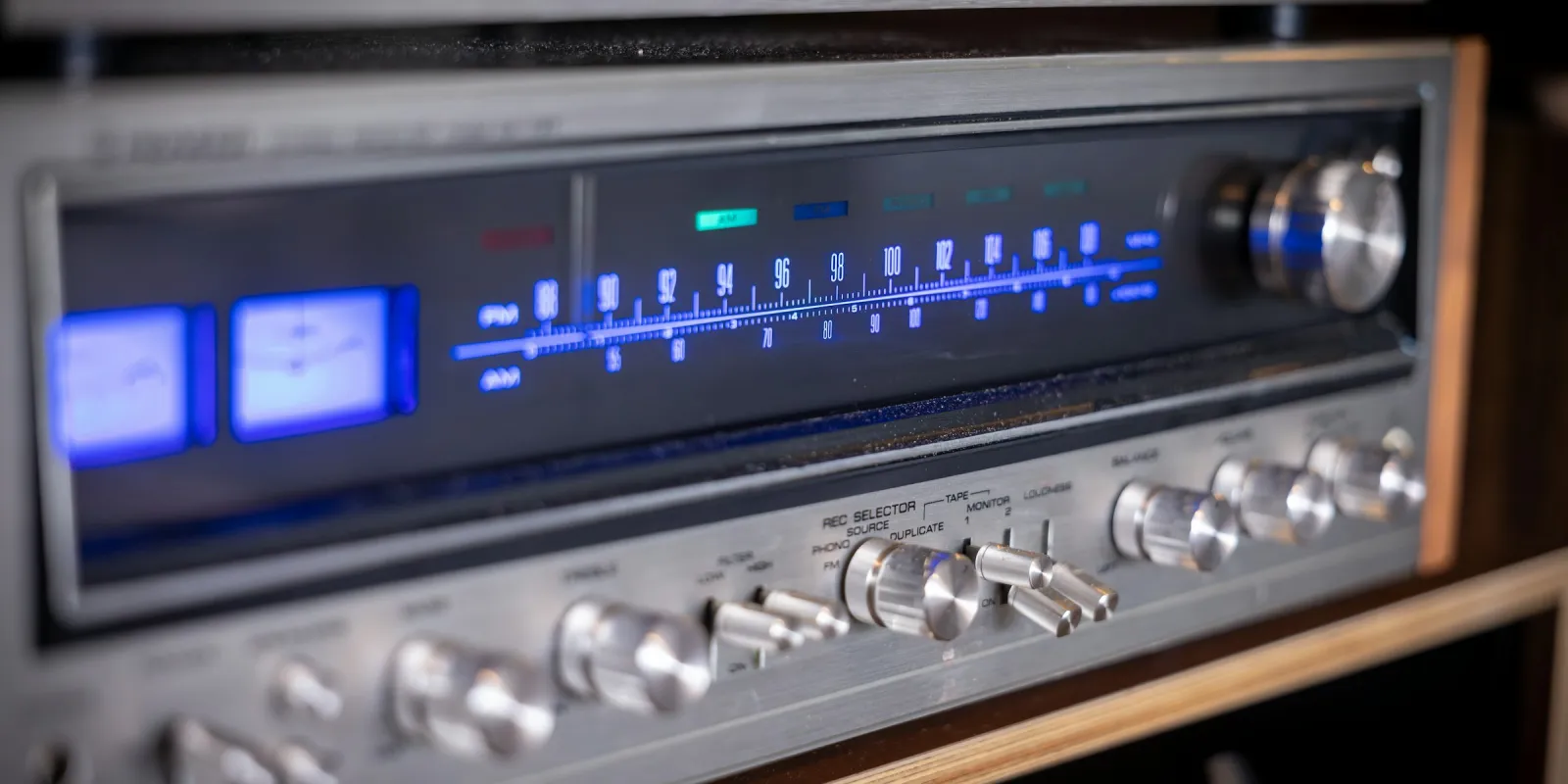
Most tower speakers are passive, so they need an external amplifier to make any sound. Choosing one is less about chasing big wattage numbers and more about three questions. What will you use the system for? How easy are your speakers to drive? And does the amplifier’s power rating mean what it seems to?
Below: the three amplifier types, how to read power specs, a formula for the watts you need, and how to handle 4-ohm speakers. To skip the math, our amplifier compatibility checker does it for you: enter your speaker and amp, and it flags likely problems.
How we researched this: This guide is based on manufacturer specifications, owner documentation, published third-party measurements and professional reviews. We have not hands-on tested these speakers unless a section says so. Our methodology
Stereo amp, AV receiver or streaming amp?
Stereo integrated amplifier
A stereo integrated amp combines a preamplifier (input switching and volume) with two channels of power. With no surround decoding or HDMI to pay for, more of the budget goes into those two channels, and many add a phono stage for a turntable. Our best tower speakers for music guide pairs well with this route.
AV receiver
An AV receiver (AVR) decodes surround formats like Dolby Atmos, switches HDMI sources, powers five or more channels, and adds subwoofer bass management and room correction. For a TV or movie system, you want an AVR. See our best tower speakers for home theater.
Streaming amplifier
A streaming amp is a compact stereo amplifier with built-in network streaming and app control. It’s tidy, but check its power rating carefully, since many have modest output. If you don’t want a separate amplifier at all, look at powered speakers. Our passive vs powered tower speakers guide explains the trade-offs.
How to read amplifier power specs
A power rating means little without its conditions. A useful rating states four things:
- Load: usually 8 ohms. Ratings at 4 or 6 ohms will be higher, so compare like with like.
- Bandwidth: ideally the full 20 Hz–20 kHz audio range. A rating at just 1 kHz is easier to achieve than across the full range.
- Distortion (THD): the total harmonic distortion at the rated power. Figures like 0.05–0.1% describe clean output. A 10% THD rating describes an amplifier that is already clipping heavily.
- Channels driven: AV receivers usually quote power with only two channels driven. With five or seven channels working hard together, each one typically gets less.
Here’s how that plays out with real manufacturer figures:
| Product | Rated power (manufacturer) | What to notice |
|---|---|---|
| Denon PMA-600NE (stereo amp) | 45 W/ch, 8 Ω, 20 Hz–20 kHz, 0.07% THD; 70 W/ch, 4 Ω, 1 kHz, 0.7% THD | The 8-ohm figure is a full-bandwidth, low-distortion rating. The 4-ohm figure uses easier conditions (1 kHz, higher THD). |
| Denon AVR-S770H (AV receiver) | 75 W/ch, 8 Ω, 20 Hz–20 kHz, 0.08% THD, 2 channels driven | Full-bandwidth rating, but two channels driven. Denon’s pages also disagree (75 vs 80 W). |
| Yamaha RX-V6A (AV receiver) | 100 W/ch, 8 Ω, 20 Hz–20 kHz, 0.06% THD, 2 channels driven | Same caveat: real multichannel output is lower. |
| Yamaha R-S202 (stereo receiver) | 140 W + 140 W “maximum”, 8 Ω, 1 kHz, 10% THD | A “maximum” figure at 1 kHz and 10% THD is not continuous full-range power. Yamaha’s US spec page doesn’t show a 20 Hz–20 kHz rating. |
The general lesson: “maximum”, “peak”, “dynamic” or “total system power” figures, and ratings at 1 kHz or high THD, all produce bigger numbers than a continuous 20 Hz–20 kHz, low-distortion rating. They aren’t comparable, so compare amplifiers on their 8-ohm, 20 Hz–20 kHz, low-THD figures.
How much power do you actually need?
The speaker’s sensitivity tells you how loud it plays from a set input. Combined with your listening distance, it lets you estimate the power you need. The standard approximation is:
SPL at your seat ≈ sensitivity + 10·log10(watts) − 20·log10(distance in meters)
Two rules of thumb follow. Every +3 dB needs roughly double the power, so a 90 dB speaker needs half the power of an 87 dB one for the same volume. And about +10 dB (ten times the power) sounds twice as loud.
Worked example
Take the Wharfedale Diamond 12.3: 89 dB sensitivity (2.83 V/1 m), 8 ohms nominal. At 8 ohms, 2.83 V is about 1 watt, so we can treat it as 89 dB per watt. Say you sit 3 meters (about 10 feet) away and want loud peaks of 95 dB at your seat.
- Distance loss: 20·log10(3) ≈ 9.5 dB. So 1 W gives about 89 − 9.5 = 79.5 dB at your seat from one speaker.
- You need 95 − 79.5 = 15.5 dB more.
- 15.5 dB means 10^(15.5/10) ≈ 35 W for one speaker.
- Two speakers playing together add roughly 3 dB, so each needs about half: around 18 W per channel for those peaks.
Now aim for 105 dB peaks, the level movie soundtracks are mixed to at full “reference” volume. That’s 10 dB more, so ten times the power: roughly 180 W per channel. That’s why few people listen at reference level at home, and why efficient speakers matter in home theaters. Treat these as rough estimates: real rooms add some bass reinforcement, and impedance varies with frequency.
Watch the sensitivity conditions
- 2.83 V into a 4-ohm speaker is about 2 W, not 1 W. The KEF Q7 Meta is rated 87 dB at 2.83 V with a 4-ohm nominal impedance, which works out to roughly 84 dB per watt. In the example above, it would need about twice the power of an 87 dB/1 W speaker.
- Polk Monitor XT models quote sensitivity at 1 W/1 m, so you can use their figures directly.
- Klipsch quotes “in-room” sensitivity, which reads several dB higher than the full-space figures most brands use. Klipsch towers are still very efficient, just not by quite as much as the numbers suggest.
Our speaker sensitivity explainer goes deeper, and the amplifier compatibility checker runs this calculation for you.
Impedance and 4-ohm loads
Impedance is the electrical load a speaker presents to the amplifier, measured in ohms. The nominal figure on the box is a simplified average. The real impedance rises and falls with frequency, and the minimum dips are what stress an amplifier. A lower impedance draws more current, which means more heat and more demand on the power supply.
Several popular towers dip well below 8 ohms:
- KEF Q7 Meta: 4 ohms nominal, 3.2 ohms minimum.
- Polk Reserve R700: 3.6 ohms minimum (Polk lists 8/6/4-ohm amp compatibility).
- ELAC Debut 3.0 DF63: 3.6 ohms minimum. ELAC’s sources disagree on whether it’s 4 or 6 ohms nominal.
- Q Acoustics 3050c: 6 ohms nominal, 3.8 ohms minimum.
With speakers like these, choose an amplifier explicitly rated for 4-ohm loads, such as the Denon PMA-600NE with its published 4-ohm rating. For AV receivers, check the manual for supported speaker loads and any impedance setting. Easy loads like the Wharfedale Diamond 12.3 (8 ohms nominal, 5.0 ohms minimum) or the 8-ohm Klipsch towers are the safest pairing for budget receivers. Our speaker impedance explainer covers this in more depth.
Headroom, clipping and “too much power”
Short musical and movie peaks can need many times the average power. Headroom is the spare capacity that lets an amplifier reproduce those peaks cleanly.
When an amplifier runs out of headroom, it clips: the tops of the waveform are flattened. Clipping sounds harsh, and sustained heavy clipping is widely considered a risk to tweeters, because it adds high-frequency energy the tweeter wasn’t expecting. That’s why a small amplifier turned all the way up can be riskier for speakers than a larger one used sensibly.
“Too much power” is rarely the real danger. A powerful amplifier only delivers what the volume control asks for. The risk is turning it up until the speaker is overdriven. Use the speaker’s recommended amplifier range as a guide (the KEF Q7 Meta lists 15–200 W, the Polk Signature Elite ES60 50–300 W), and turn down when the sound gets strained.
Bi-wiring and bi-amping, briefly
Some towers have two pairs of binding posts, joined by removable jumpers. Examples include the Klipsch RP-8000F II, Polk Reserve R700, Polk Signature Elite ES55 and ES60, and Yamaha NS-555. This lets you:
- Bi-wire: run separate cables from one amplifier channel to the treble and bass sections. Benefits are debated and likely small.
- Bi-amp: drive each section from its own amplifier channel. Some AV receivers can reassign unused surround-back channels for this. Because the speaker’s internal crossover still does the splitting, the gain from identical channels in one receiver is typically modest. Adding a subwoofer usually helps more.
If you try either, remove the jumpers first when using separate amp channels. Otherwise you’ll connect two amplifier outputs together.
Amplifiers worth considering
Three widely available options cover most tower speaker systems. Specs are from the manufacturers.
Denon PMA-600NE (stereo integrated amp). A published 4-ohm rating and a built-in phono stage make it a good fit for efficient speakers in small and medium rooms, and for vinyl listeners. Check current price on Amazon.
A stereo integrated amplifier with a phono stage, Bluetooth and digital inputs — a sensible music-first partner for tower speakers.
Denon AVR-S770H (7.2-channel AV receiver). Audyssey room correction, eARC and HEOS streaming. A sensible match for efficient, 6–8-ohm towers in a living-room theater. View on Amazon.
A 7.2-channel 8K receiver with Audyssey room correction and HEOS streaming — a capable hub for tower speakers in a home theater.
Yamaha RX-V6A (7.2-channel AV receiver). The highest rated output of these three, plus YPAO room correction and Dolby Atmos/DTS:X decoding. See available options.
A 7.2-channel receiver with YPAO room correction and Dolby Atmos/DTS:X support.
Quick matching checklist
- Use: music only → stereo integrated amp. Movies or TV → AV receiver.
- Load: if the speaker’s minimum impedance is under about 4 ohms, or its nominal rating is 4 ohms, choose an amp rated for 4-ohm loads.
- Power: estimate the watts you need from sensitivity and distance, then add headroom.
- Compare honestly: use 8-ohm, 20 Hz–20 kHz, low-THD ratings. Discount “maximum” or 1 kHz figures.
- Check fit: HDMI/eARC for a TV, a phono stage for vinyl, a subwoofer output or preamp outputs if you plan to add a sub.
Browse speaker options in our main guide to the best tower speakers.
Frequently asked questions
How many watts do I need for tower speakers?
Less than most people expect. With an 89 dB, 8-ohm speaker at about 10 feet, roughly 18 W per channel reaches loud 95 dB peaks in our worked example. Low-sensitivity or 4-ohm speakers, large rooms and movie-level peaks need more. Aim for comfortable headroom above your estimate rather than the biggest number you can find.
Can I use an AV receiver for stereo music?
Yes. Every AV receiver has a stereo mode, and many add room correction and subwoofer bass management that stereo amps lack. The trade-off is that you pay for surround channels and HDMI features you won’t use for music. A stereo integrated amp is often better value for two-channel systems, and many include a phono stage.
Is it bad to use a 4-ohm speaker with an 8-ohm amplifier?
It can be, if the amp isn’t designed for it. A 4-ohm load draws more current, so the amp runs hotter and may shut down or distort at high volume. Check that the manufacturer rates the amp for 4-ohm speakers or provides a 4-ohm rating. Many receivers handle moderate 4-ohm loads at sensible volumes, but avoid pushing them hard.
Can too much amplifier power damage my speakers?
Power itself doesn’t damage speakers. Turning the volume up too far does. A large amp used sensibly is often safer than a small amp driven into clipping, which produces harsh distortion that can stress tweeters. Stay within the speaker’s recommended amplifier range, and turn down when the sound gets strained or distorted.
Next steps
Check your shortlist with the amplifier compatibility checker, learn more about the specs involved in speaker impedance explained, and if you plan to add bass, read do tower speakers need a subwoofer?
Leave a Reply