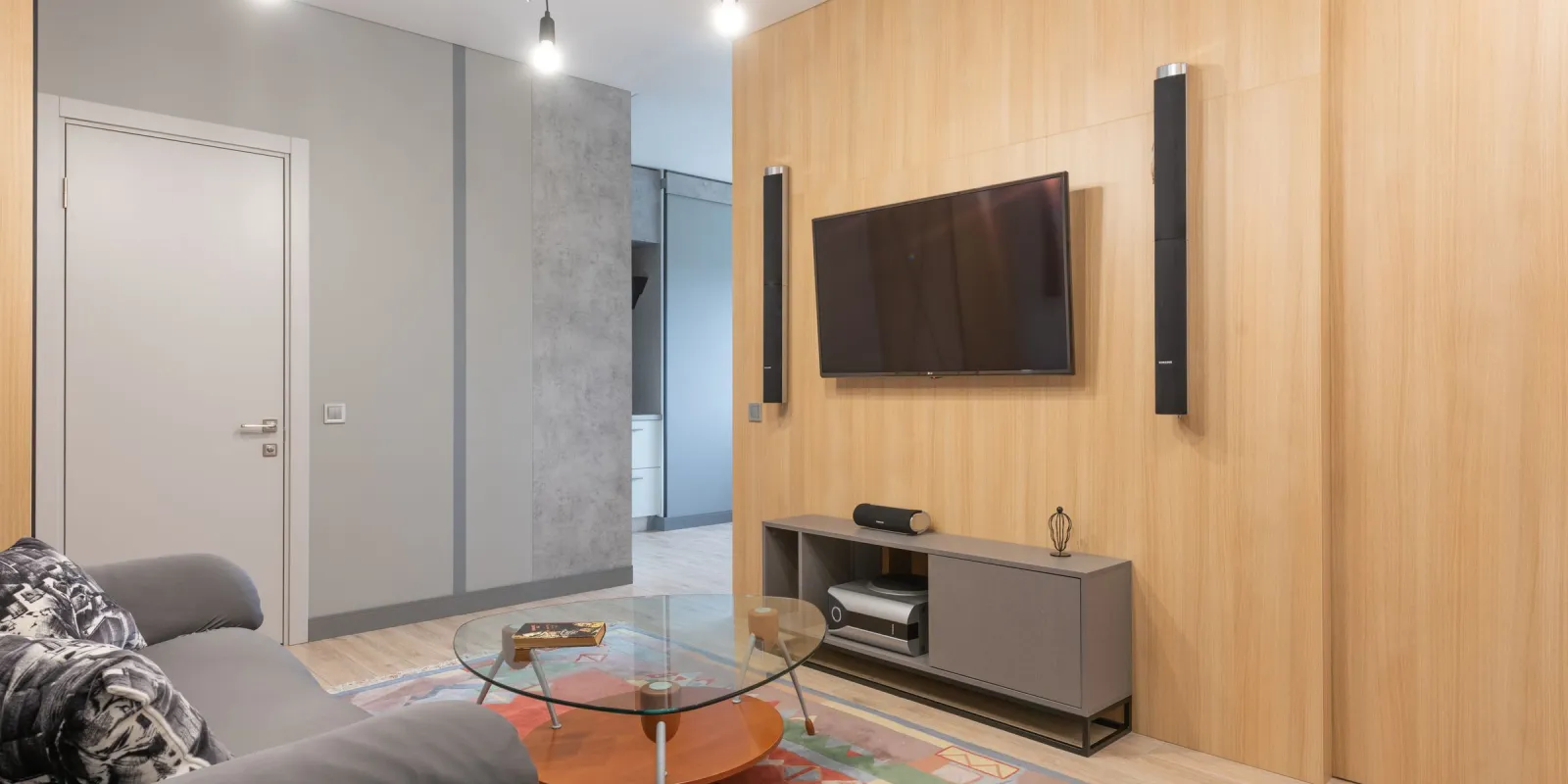
Tower speakers can work well in a small room, but the room changes the rules. In a bedroom, home office or apartment living room, the speakers usually sit close to the wall behind them, you sit close to the speakers, and bass bounces around a confined space. A tower that sounds balanced in a big showroom can sound boomy and muddled in a 12 × 12 ft room.
The best small-room towers share a few traits. They have a slim footprint, a bass system that tolerates being near a wall, and enough sensitivity for a compact amplifier. The six picks below were chosen with those traits in mind. We also cover why port location matters so much, and when a pair of bookshelf speakers is simply the better answer.
We have not hands-on tested these speakers. The picks are based on manufacturer specifications and our editorial analysis.
How we researched this: This guide is based on manufacturer specifications, owner documentation, published third-party measurements and professional reviews. We have not hands-on tested these speakers unless a section says so. Our methodology
Why small rooms are different
Three things happen when you put tower speakers in a small space:
- Boundary bass boost. Bass gets louder as a speaker moves closer to a wall, and louder again near a corner. A speaker voiced for open space can turn thick and boomy when pushed back against a wall.
- Room modes. Every room has resonant frequencies set by its dimensions. In a small room these sit higher in the bass range and are spaced further apart, so some bass notes swell while others nearly vanish depending on where you sit. Seats near the middle of the room or right against the back wall are often the worst.
- Short listening distance. You sit closer, so you need less volume and less amplifier power. But you can also hear the individual drivers more easily if the speaker doesn’t blend them well at close range.
None of this means towers are a bad idea. It means you should favor slim towers with modest bass output and a bass system that copes with nearby walls. Our room planner can help you sketch where the speakers and your seat will go before you buy.
Why port location matters near walls
Most towers are bass reflex designs. A tuned opening, the port, extends bass output. Where that port points changes how the speaker behaves near a wall:
- Rear-firing ports blow straight at the wall behind the speaker. Too close, and bass can become boomy or uneven. These designs usually want the most clearance.
- Front-firing ports are generally less sensitive to the rear wall, although the speaker’s distance from the wall still affects bass.
- Floor-firing ports, like the Polk Reserve R600’s, fire into the gap between the cabinet and its base. Rear-wall distance matters less to them, though the floor surface plays a role.
- Port bungs are foam plugs that partly or fully close a port. They trade a little bass extension for tighter, less boomy bass near a wall. KEF supplies one with the Q7 Meta.
Passive radiators are an alternative to ports. A passive radiator is an unpowered cone, driven by air pressure inside the cabinet, that does a port’s job without an opening. The Polk Monitor XT60 uses two. Passive radiators don’t make room effects disappear, but they avoid port noise and don’t blow air at the wall.
Best overall for small rooms: Wharfedale Diamond 12.3
The Diamond 12.3 is close to an ideal small-room tower on paper. It is a slim (7.1 in. wide) 2.5-way with a 1 in. textile-dome tweeter and two 5 in. drivers. Smaller woofers produce less deep bass, which is often an advantage in a small room, where excess bass is the usual problem. Wharfedale quotes 45 Hz–20 kHz ±3 dB (40 Hz at −6 dB). That is plenty for a bedroom or office.
The other strength is how easy it is to drive. It is rated 8 ohms nominal with a 5.0-ohm minimum and 89 dB sensitivity, so a compact stereo amp will be comfortable. Wharfedale doesn’t state the port location or whether it’s sold singly or in pairs, so check both before ordering. Check current price on Amazon.
Wharfedale Diamond 12.3
A slim 7.1 in. wide 2.5-way tower with an easy 8-ohm-compatible load — a natural fit for smaller rooms and modest stereo amplifiers.
- Design2.5-way passive
- Drivers1 in. (25 mm) textile dome tweeter, 5 in. (130 mm) mid/bass, 5 in. (130 mm) bass (Klarity PP cones)
- Frequency response45 Hz–20 kHz +/- 3 dB (40 Hz at -6 dB)
- Sensitivity89 dB (2.83V)
- Impedance8 Ω nominal (5.0 Ω min)
- Amp power30-150 W
- Dimensions38.4 × 7.1 × 13.7 in. (H×W×D)
- Weight43.0 lb
Advantages
- Slim cabinet suits smaller rooms
- Easy load: 8 Ω compatible, 5 Ω minimum
- Response quoted ±3 dB (45 Hz–20 kHz)
Limitations
- Smaller 5 in. drivers limit deep bass
- Port location not documented
- Pair/single status — check listing
Best budget: Polk Monitor XT60
The Monitor XT60 is the lightest and most compact tower here: 36.4 in. tall, 7.5 in. wide, 9.09 in. deep and 20 lb. Instead of a port it uses two 6.5 in. passive radiators alongside a single 6.5 in. woofer, which makes placement near a wall less critical than with a rear-ported speaker. Polk doesn’t state where the passive radiators are mounted.
Polk quotes 38 Hz–40 kHz with no tolerance, and 86 dB sensitivity measured at 1 W/1 m. That’s on the low side, but in a small room you sit close and need less volume, so most entry-level receivers will cope. Polk lists no nominal impedance, only “compatible with 4- and 8-ohm outputs.” It is sold individually, so budget for two. Our Polk Monitor XT60 review has more detail. View on Amazon.
Polk Audio Monitor XT60
A slim, light entry-level tower that uses passive bass radiators instead of a port — an easy, affordable first step up from bookshelf speakers.
- Design2-way passive
- Drivers1 in. Terylene dome tweeter, 1x 6.5 in. bi-laminate paper woofer, 2x 6.5 in. passive bass radiators
- Frequency response38 Hz–40 kHz
- Sensitivity86 dB (1W)
- Impedance4–8 Ω amp compatible
- Amp power25-200 W per channel
- Dimensions36.4 × 7.5 × 9.09 in. (H×W×D)
- Weight20 lb
Advantages
- Slim 7.5 in. wide cabinet is easy to fit
- Passive radiators instead of a port ease near-wall placement
- Wide 25–200 W amplifier range
Limitations
- 86 dB (1W) sensitivity needs some amplifier headroom
- No published nominal impedance
- Sold individually — buy two
Best premium pick: KEF Q7 Meta
The Q7 Meta brings KEF’s Uni-Q driver to a moderately sized tower. A 0.75 in. tweeter sits in the center of a 4 in. midrange cone, with two 6.5 in. bass cones below. Small rooms put you close to the speakers and often off-axis, and a point-source design like this is meant to keep the sound consistent across a wide area. KEF quotes 46 Hz–20 kHz ±3 dB (39 Hz at −6 dB).
The small-room feature is the supplied port bung. KEF doesn’t state the port location, but the bung gives you a way to rein in bass if the speakers must sit near a wall. Note the footprint: 8.3 in. wide without its plinth, but 12.5 in. with it. The load is demanding too, at 4 ohms nominal and 3.2 ohms minimum, so choose a 4-ohm-capable amplifier. It is sold individually. See available options.
KEF Q7 Meta
KEF’s Uni-Q point-source driver with Metamaterial Absorption Technology aims for precise imaging; a port bung helps in smaller rooms.
- Design3-way passive
- DriversUni-Q array (0.75 in. vented aluminum dome tweeter with MAT + 4 in. aluminum midrange cone), 2x 6.5 in. hybrid aluminum bass cones
- Frequency response46 Hz–20 kHz +/- 3 dB (39 Hz–20 kHz at -6 dB)
- Sensitivity87 dB (2.83V)
- Impedance4 Ω nominal (3.2 Ω min)
- Amp power15-200 W
- Dimensions39.4 × 12.5 × 12.4 in. (H×W×D)
- Weight40.6 lb
Advantages
- Uni-Q coincident driver for even dispersion
- Response quoted ±3 dB (46 Hz–20 kHz)
- Port bung included for near-wall use
Limitations
- 4 Ω nominal (3.2 Ω min) needs a capable amp
- 87 dB sensitivity is average
- Sold individually
Floor-firing port: Polk Reserve R600
The Reserve R600 solves the rear-wall problem in its design. Its Power Port with X-Port fires down toward the floor, so rear-wall distance matters less than with a rear-ported tower. It is a 2-way with a 1 in. Pinnacle Ring Radiator tweeter and two 6.5 in. Turbine Cone woofers. Polk quotes 43 Hz–38 kHz at −3 dB, a helpfully clear figure.
Two things to weigh in a small room. The footprint isn’t tiny: 11.1 in. wide and 15.0 in. deep including its feet. And the 4.0-ohm minimum impedance means you should check your amplifier’s 4-ohm rating. Sensitivity is 87.5 dB and spike and pad feet are included. It is sold individually. Check current availability.
Polk Audio Reserve R600
Polk’s premium Reserve series in a compact tower, with a ring-radiator tweeter and a floor-firing port that is less fussy about rear-wall distance.
- Design2-way passive
- Drivers1 in. Pinnacle Ring Radiator tweeter, 2x 6.5 in. Turbine Cone woofers
- Frequency response43 Hz–38 kHz (-3 dB); 32 Hz–50 kHz overall
- Sensitivity87.5 dB (2.83V)
- Impedance4.0 Ω minimum
- Amp power25-200 W
- Dimensions41.9 × 11.1 × 15.0 in. (H×W×D)
- Weight47.3 lb
Advantages
- Floor-firing port eases placement near walls
- Response quoted with a −3 dB tolerance (43 Hz–38 kHz)
- Spike and pad feet included
Limitations
- 4 Ω minimum impedance — check your amplifier
- Only two-way at this price
- Sold individually
Narrowest pick: ELAC Debut 3.0 DF53
At 6.8 in. wide and 9.7 in. deep, the DF53 has the narrowest cabinet in this guide. It is still a 3-way, with a 1 in. aluminum tweeter, a 5.25 in. midrange and two 5.25 in. woofers. That combination is unusual at this size and suits buyers who want a dedicated midrange in a tight space.
ELAC quotes 38 Hz–38 kHz at −6 dB, a looser tolerance than ±3 dB, and 87.5 dB sensitivity. Its documentation disagrees on impedance: the web page says 6 ohms nominal, the sales sheet says 4 ohms with a 4.2-ohm minimum. A 4-ohm-capable amp is the safe choice. ELAC uses dual flared ports but doesn’t say where they are, so start with some space behind the speaker. Outrigger feet and spikes are included, and it’s sold in different configurations depending on the retailer. Explore on Amazon.
ELAC Debut 3.0 DF53
A very slim (6.8 in. wide) 3-way tower from ELAC’s latest Debut range — a tidy fit for smaller rooms.
- Design3-way passive
- Drivers1 in. aluminum dome tweeter, 1x 5.25 in. aramid-fiber midrange, 2x 5.25 in. aramid-fiber woofers
- Frequency response38 Hz–38 kHz (-6 dB)
- Sensitivity87.5 dB (2.83V)
- Impedance4–6 Ω (sources differ; min 4.2 Ω)
- Amp power30-150 W
- Dimensions40.6 × 6.8 × 9.7 in. (H×W×D)
- Weight34.6 lb
Advantages
- True 3-way design in a 6.8 in. wide cabinet
- Outrigger feet and spikes included
- Magnetic grilles
Limitations
- ELAC sources differ on nominal impedance (4 vs 6 Ω)
- Response quoted at −6 dB (looser tolerance)
- Small 5.25 in. woofers
Efficient and sold as a pair: Q Acoustics 3050c
The 3050c is a simple 2-way with a 0.9 in. tweeter and two 5.5 in. bass units. Its 90 dB sensitivity (2.83 V at 1 kHz) is the highest of these picks, which suits a small room driven by a compact integrated amp. It is also sold as a pair, which makes budgeting easier.
Q Acoustics quotes 42 Hz–30 kHz at −6 dB, with 6 ohms nominal and a 3.8-ohm minimum. Q Acoustics doesn’t state the port location in the specs we checked. The quoted 12.4 in. width includes the stabilizer outriggers, so measure that footprint rather than the cabinet alone. Check Price on Amazon.
Q Acoustics 3050c
A compact, sensitive 2-way tower sold as a pair, with stabilizer outriggers and spikes included.
- Design2-way passive
- Drivers0.9 in. (22 mm) tweeter, 2x 5.5 in. (142 mm) bass units
- Frequency response42 Hz–30 kHz (-6 dB)
- Sensitivity90.0 dB (2.83V)
- Impedance6 Ω nominal (3.8 Ω min)
- Amp power25-150 W
- Dimensions40.2 × 12.4 × 12.4 in. (H×W×D)
- Weight39.4 lb
Advantages
- Sold as a pair
- 90 dB sensitivity
- Outriggers and spikes included
Limitations
- 3.8 Ω minimum — check your amp’s 4-ohm rating
- Response quoted at −6 dB
- Only two 5.5 in. bass units
Small-room towers compared
Manufacturer specifications only. Width matters in small rooms, and note that some brands quote it with outriggers or plinths.
| Product | Design | Frequency response | Sensitivity | Impedance | Dimensions | Sold as | Best for | Amazon |
|---|---|---|---|---|---|---|---|---|
| Wharfedale Diamond 12.3 | 2.5-way passive | 45 Hz–20 kHz +/- 3 dB (40 Hz at -6 dB) | 89 dB (2.83V) | 8 Ω nominal (5.0 Ω min) | 38.4 × 7.1 × 13.7 in. (H×W×D) | Check listing | Best for Small Rooms | View |
| Polk Audio Monitor XT60 | 2-way passive | 38 Hz–40 kHz | 86 dB (1W) | 4–8 Ω amp compatible | 36.4 × 7.5 × 9.09 in. (H×W×D) | Single speaker | Best Budget | View |
| KEF Q7 Meta | 3-way passive | 46 Hz–20 kHz +/- 3 dB (39 Hz–20 kHz at -6 dB) | 87 dB (2.83V) | 4 Ω nominal (3.2 Ω min) | 39.4 × 12.5 × 12.4 in. (H×W×D) | Single speaker | Best for Audiophiles | View |
| Polk Audio Reserve R600 | 2-way passive | 43 Hz–38 kHz (-3 dB); 32 Hz–50 kHz overall | 87.5 dB (2.83V) | 4.0 Ω minimum | 41.9 × 11.1 × 15.0 in. (H×W×D) | Single speaker | Premium compact tower | View |
| ELAC Debut 3.0 DF53 | 3-way passive | 38 Hz–38 kHz (-6 dB) | 87.5 dB (2.83V) | 4–6 Ω (sources differ; min 4.2 Ω) | 40.6 × 6.8 × 9.7 in. (H×W×D) | Check listing | Slim 3-way | View |
| Q Acoustics 3050c | 2-way passive | 42 Hz–30 kHz (-6 dB) | 90.0 dB (2.83V) | 6 Ω nominal (3.8 Ω min) | 40.2 × 12.4 × 12.4 in. (H×W×D) | Pair | Sold as a pair | View |
Specifications are manufacturer-published figures. Measurement methods differ between brands, so treat small differences with caution.
Taming bass in a small room
Most complaints about towers in small rooms come down to bass: too much of it, or very uneven bass from seat to seat. Try these steps in order:
- Move the speakers. Pull them out from the wall and away from corners. A few inches can make an audible difference.
- Move your seat. Avoid sitting exactly halfway across the room or with your head against the back wall, where room modes are often worst.
- Use the tools you have. Fit port bungs if supplied. Run your receiver’s room correction (Audyssey, YPAO and similar) if you’re using an AV receiver.
- Add soft furnishings. Rugs, curtains and a sofa help with echo and treble reflections, though they do little for deep bass.
- Consider a small subwoofer. It sounds backwards, but a separate sub can be placed where bass is smoothest, letting the towers play only above about 80 Hz. Our guide to whether tower speakers need a subwoofer explains how.
For more on angles and distances, see our floorstanding speaker positioning guide.
When bookshelf speakers are the better choice
A tower isn’t always right for a small room. Bookshelf (standmount) speakers may be the better choice when:
- The room is very small or the speakers must sit right against a wall. Smaller cabinets produce less bass, which can be exactly what a tiny room needs.
- Floor space is scarce. Bookshelf speakers can go on a shelf, a desk or wall brackets. Towers can’t.
- You plan to add a subwoofer anyway. Then the tower’s extra bass is less important, and a bookshelf-plus-sub system gives you more placement flexibility.
Towers make more sense when you have a few feet of floor space on each side of a TV or equipment rack, want fuller sound without a subwoofer, or don’t want to buy stands. Our tower speakers vs bookshelf speakers comparison covers the trade-offs in detail.
How to choose a tower for a small room
- Measure first. Check width and depth, including outriggers or plinths, and the space behind the speaker.
- Favor wall-friendly bass designs. Passive radiators (Polk XT60), floor-firing ports (Polk R600) or a supplied port bung (KEF Q7 Meta) give you more placement freedom.
- Don’t chase low bass figures. In a small room, 40–45 Hz is plenty. Response figures without a tolerance aren’t comparable anyway.
- Match the amplifier. You need less power in a small room, but 4-ohm loads (KEF Q7 Meta, ELAC DF53 per its sales sheet) still call for a 4-ohm-capable amp.
For bigger spaces and broader picks, see our guide to the best tower speakers.
Frequently asked questions
Are tower speakers too big for a small room?
Not necessarily. Slim towers with 5–6.5 in. drivers work well in many bedrooms, offices and apartments, as long as you can give them some space from the wall. Problems usually come from excess bass, not physical size. If the speakers must sit right against a wall or on furniture, bookshelf speakers are often the better fit.
How far from the wall should tower speakers be in a small room?
Start with about one to two feet between the back of the speaker and the wall, then adjust by ear. Rear-ported towers usually need more space than designs with floor-firing ports or passive radiators. If bass sounds boomy, move the speakers out a few inches at a time, or use a port bung if one is supplied.
Are passive radiators better than ports for small rooms?
They can make placement easier because there’s no port blowing air at the wall, and they avoid port noise. But they don’t eliminate room effects: bass still builds up near walls and corners. A floor-firing port or a well-designed front port can be just as practical. Bass tuning and placement matter more than the technology.
Do I need a subwoofer with tower speakers in a small room?
Usually not for music, because small rooms already reinforce bass. A small subwoofer can still help with movies, or when room modes make bass uneven, because you can place it where the bass sounds smoothest and let the towers handle everything above about 80 Hz.
Next steps
Map your room and speaker positions with the room planner, check amplifier compatibility with the amplifier compatibility checker, and if the system is mainly for listening to records and streaming, compare these picks with our best tower speakers for music.
Leave a Reply