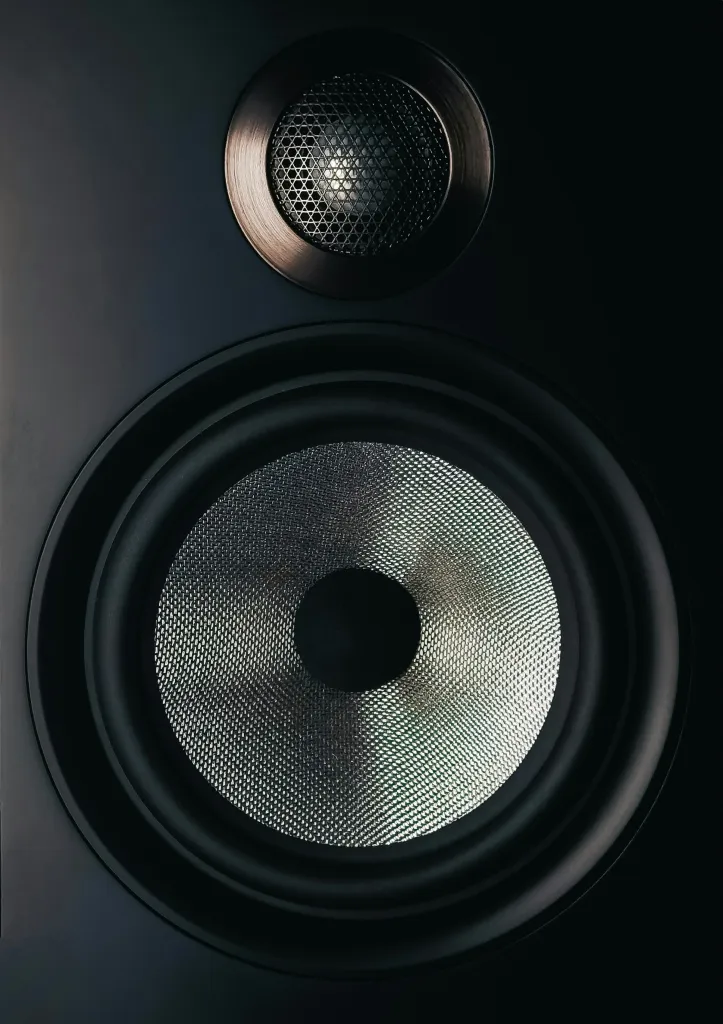
A 3-way speaker splits the sound into three bands — bass, midrange and treble — with a dedicated driver for each. Giving vocals and instruments their own midrange driver can improve clarity and reduce strain on the woofers, though a well-designed 2-way can still outperform a poorly designed 3-way.
This guide originally featured the SVS Prime Tower, Klipsch RP-8000F and KEF R7. We’ve corrected one error — the Klipsch RP-8000F is actually a 2-way design (a horn tweeter plus two woofers) — and refreshed the list with current 3-way towers.
How we researched this: This guide is based on manufacturer specifications, owner documentation, published third-party measurements and professional reviews. We have not hands-on tested these speakers unless a section says so. Our methodology
What are 3-way floor-standing speakers?
In a 3-way speaker, a crossover divides the signal three ways: woofers handle bass, a midrange driver handles roughly the vocal range, and a tweeter covers treble. In a 2.5-way design, two woofers share bass but only one continues into the midrange. Read the full explanation in 2-way vs 3-way speakers.
Benefits
- A dedicated midrange can reproduce vocals with lower distortion.
- Woofers can be optimized purely for bass.
- Often better power handling and dynamics.
Trade-offs: more complex crossovers, and more design work needed to blend three drivers smoothly.
Current 3-way picks
ELAC Debut 3.0 DF63
The larger Debut 3.0 tower: a 3-way with 6.5 in. drivers and 31 Hz (−6 dB) extension in a slim 7.7 in. cabinet.
- Design3-way passive
- Drivers1 in. aluminum dome tweeter, 1x 6.5 in. aramid-fiber midrange, 2x 6.5 in. aramid-fiber woofers
- Frequency response31 Hz–38 kHz (-6 dB)
- Sensitivity87.5 dB (2.83V)
- Impedance4–6 Ω (sources differ; min 3.6 Ω)
- Amp power30-180 W
- Dimensions43.1 × 7.7 × 10.6 in. (H×W×D)
- Weight38.8 lb
Advantages
- True 3-way with dedicated midrange
- 31 Hz rated extension (−6 dB)
- Slim cabinet with outriggers and spikes
Limitations
- 3.6 Ω minimum — choose a 4-ohm-capable amp
- ELAC sources differ on nominal impedance
- 87.5 dB sensitivity is average
KEF Q7 Meta
KEF’s Uni-Q point-source driver with Metamaterial Absorption Technology aims for precise imaging; a port bung helps in smaller rooms.
- Design3-way passive
- DriversUni-Q array (0.75 in. vented aluminum dome tweeter with MAT + 4 in. aluminum midrange cone), 2x 6.5 in. hybrid aluminum bass cones
- Frequency response46 Hz–20 kHz +/- 3 dB (39 Hz–20 kHz at -6 dB)
- Sensitivity87 dB (2.83V)
- Impedance4 Ω nominal (3.2 Ω min)
- Amp power15-200 W
- Dimensions39.4 × 12.5 × 12.4 in. (H×W×D)
- Weight40.6 lb
Advantages
- Uni-Q coincident driver for even dispersion
- Response quoted ±3 dB (46 Hz–20 kHz)
- Port bung included for near-wall use
Limitations
- 4 Ω nominal (3.2 Ω min) needs a capable amp
- 87 dB sensitivity is average
- Sold individually
Polk Audio Reserve R700
A full 3-way with a sealed midrange and two 8 in. woofers — Polk’s step toward high-end performance for larger rooms.
- True 3-way design with sealed midrange enclosure
- Two 8 in. woofers; 38 Hz (−3 dB)
- Floor-firing port
- Design3-way passive
- Drivers1 in. Pinnacle Ring Radiator tweeter, 1x 6.5 in. Turbine Cone midrange, 2x 8 in. polypropylene woofers
- Sensitivity88 dB (2.83V)
- Impedance3.6 Ω minimum
Yamaha NS-555
A 3-way tower with waveguide-loaded tweeter and midrange, designed as a natural partner for Yamaha AV receivers.
- True 3-way with waveguides
- 35 Hz rated extension
- Bi-wiring terminals
- Design3-way passive
- Drivers1 in. aluminum dome tweeter with waveguide horn, 5 in. cone midrange with waveguide horn, 2x 6.5 in. PMD cone woofers
- Sensitivity88 dB (2.83V)
- Impedance6 Ω nominal
Fluance Signature HFF
A tall 3-way tower with dual 8 in. woofers sold as a pair — lots of cabinet and driver area for the money.
- Sold as a pair
- Dual 8 in. woofers plus dedicated midrange
- Outriggers and isolation spikes included
- Design3-way
- Drivers1 in. neodymium silk dome tweeter, 5 in. woven glass fiber midrange, 2x 8 in. polypropylene woofers
- Sensitivity89 dB (2.83V)
- Impedance8 Ω nominal
From our original list, the SVS Prime Tower (3-way, 1-inch tweeter, 4.5-inch midrange, dual 6.5-inch woofers) is still offered by retailers: check SVS Prime Tower availability. The KEF R7 has been succeeded by the R7 Meta.
Comparison table
| Product | Design | Drivers | Frequency response | Sensitivity | Impedance | Dimensions | Sold as | Best for | Amazon |
|---|---|---|---|---|---|---|---|---|---|
| ELAC Debut 3.0 DF63 | 3-way passive | 1 in. aluminum dome tweeter, 1x 6.5 in. aramid-fiber midrange, 2x 6.5 in. aramid-fiber woofers | 31 Hz–38 kHz (-6 dB) | 87.5 dB (2.83V) | 4–6 Ω (sources differ; min 3.6 Ω) | 43.1 × 7.7 × 10.6 in. (H×W×D) | Check listing | Best Under $1,000 | View |
| KEF Q7 Meta | 3-way passive | Uni-Q array (0.75 in. vented aluminum dome tweeter with MAT + 4 in. aluminum midrange cone), 2x 6.5 in. hybrid aluminum bass cones | 46 Hz–20 kHz +/- 3 dB (39 Hz–20 kHz at -6 dB) | 87 dB (2.83V) | 4 Ω nominal (3.2 Ω min) | 39.4 × 12.5 × 12.4 in. (H×W×D) | Single speaker | Best for Audiophiles | View |
| Polk Audio Reserve R700 | 3-way passive | 1 in. Pinnacle Ring Radiator tweeter, 1x 6.5 in. Turbine Cone midrange, 2x 8 in. polypropylene woofers | 38 Hz–38 kHz (-3 dB); 30 Hz–50 kHz overall | 88 dB (2.83V) | 3.6 Ω minimum | 45.0 × 12.6 × 16.9 in. (H×W×D) | Single speaker | Premium 3-way | View |
| Yamaha NS-555 | 3-way passive | 1 in. aluminum dome tweeter with waveguide horn, 5 in. cone midrange with waveguide horn, 2x 6.5 in. PMD cone woofers | 35 Hz–35 kHz | 88 dB (2.83V) | 6 Ω nominal | 38.6 × 8.75 × 13.6 in. (H×W×D) | Single speaker | AV receiver partner | View |
| Fluance Signature HFF | 3-way | 1 in. neodymium silk dome tweeter, 5 in. woven glass fiber midrange, 2x 8 in. polypropylene woofers | 35 Hz–20 kHz | 89 dB (2.83V) | 8 Ω nominal | 47.3 × 10.9 × 15.4 in. (H×W×D) | Pair | Big 3-way value | View |
Specifications are manufacturer-published figures. Measurement methods differ between brands, so treat small differences with caution.
Setting up 3-way towers
- Keep tweeters and midrange roughly at seated ear height.
- Form an equilateral listening triangle and fine-tune toe-in.
- Check impedance: some 3-ways dip low (ELAC DF63 minimum 3.6 Ω, KEF Q7 Meta 3.2 Ω).
How a 3-way crossover works
A crossover is a filter network that sends each frequency band to the right driver. In a typical 3-way tower, the woofers might handle frequencies below a few hundred hertz, the midrange covers roughly the vocal band up to a few kilohertz, and the tweeter takes over above that. Polk’s Reserve R700, for example, lists crossover points of 350 Hz and 2,700 Hz. The exact points, filter slopes and how smoothly the drivers overlap determine how seamless the speaker sounds.
Choosing the right 3-way tower for your room
- Small to medium rooms: slim 3-ways such as the ELAC Debut 3.0 DF53/DF63 or KEF Q7 Meta.
- Larger rooms: bigger woofers and cabinets, such as the Polk Reserve R700 or Fluance Signature HFF.
- AV receivers: check impedance; 3-ways often dip lower than 2-ways.
- Placement: a dedicated midrange helps vocals, but only if the tweeter and midrange are near ear height and the speakers form a good listening triangle.
Setting up your 3-way speakers
- Start 2–3 feet from the back wall and 1.5–2 feet from side walls.
- Toe in toward the listening position.
- Use spikes on carpet or pads on hard floors for stability.
- Run your receiver’s room correction, then fine-tune by ear.
Frequently asked questions
Are 3-way speakers better than 2-way?
Not automatically. A 3-way can offer cleaner midrange and better dynamics, but crossover quality matters more than driver count.
Is the Klipsch RP-8000F a 3-way speaker?
No — it’s a 2-way design with a horn-loaded tweeter and two 8-inch woofers. Our earlier version of this page listed it incorrectly.
Do 3-way speakers need more power?
Not necessarily; it depends on sensitivity and impedance. Check your pairing with our compatibility checker.
Related guides: 2-way vs 3-way · SVS Prime Tower review · Best for audiophiles

Leave a Reply