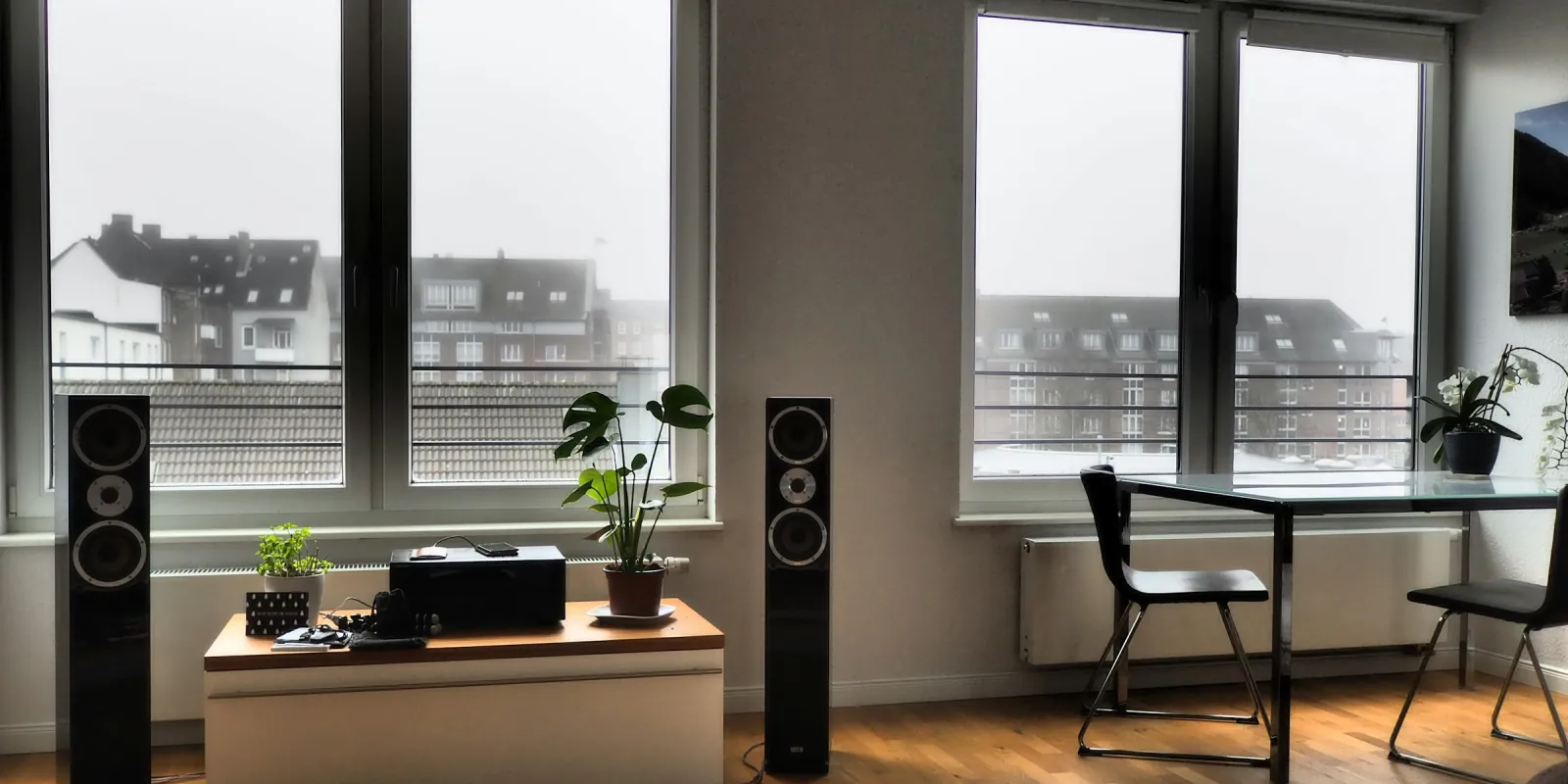
A tower speaker is a tall loudspeaker that stands directly on the floor instead of on a shelf or stand. You will also see them called floorstanding speakers or simply floorstanders. They are the classic choice for the left and right channels of a stereo system or the front pair of a home theater.
What makes a tower different from a bookshelf speaker is not magic. It is mostly a bigger box, more (or larger) drivers, and a tweeter that sits close to seated ear height without a stand. This guide walks through each part, explains why the tall shape matters, and helps you decide whether towers make sense for your space.
Tower speakers in one minute
Every tower speaker does the same basic job: it turns an electrical signal from an amplifier into sound across the audible range. Low notes (bass) need large, moving surfaces and air; high notes (treble) need a small, light diaphragm that can move very quickly. No single driver does both well, so speakers split the work between several drivers and use a filter circuit to send each one the right frequencies.
A tower simply has room for more of that hardware. Where a bookshelf speaker typically has one tweeter and one woofer, towers commonly use two or three bass drivers, and some add a dedicated midrange driver.
Anatomy of a tower speaker
Here is what you will find in, or on, a typical passive tower. The product examples below come from manufacturer specifications.
Tweeter
The tweeter reproduces treble: cymbals, the “s” in vocals, the air around instruments. Most are about 1 inch across. Domes are made of fabric, aluminum, or other materials. Some sit in a waveguide or horn that shapes how the sound spreads; the Klipsch R-800F, for example, mounts a 1-inch aluminum tweeter on a horn, which is one reason Klipsch speakers are known for high sensitivity.
Midrange driver
The midrange covers the band where voices and most instruments live. In a 3-way design, a dedicated driver handles it. The ELAC Debut 3.0 DF63 uses a 6.5-inch midrange, while the KEF Q7 Meta places a 4-inch midrange cone around its tweeter in a single concentric unit (KEF calls this Uni-Q). Not every tower has a separate midrange; in a 2-way design the woofers cover midrange too. Our guide to 2-way vs 3-way speakers explains the trade-offs, including the in-between 2.5-way layout.
Woofers
Woofers handle bass. Towers typically use two or three, often 5.25 to 8 inches each. More cone area moves more air, which helps output and low-end weight. The Polk Signature Elite ES60, for instance, lists three 6.5-inch woofers.
Cabinet
The cabinet (or enclosure) is more than a box. It holds the drivers rigidly, and its internal air volume directly affects how deep the bass can go. Internal bracing reduces panel vibration that can color the sound.
Port or passive radiator
Most towers are bass reflex designs: a tuned opening, called a port, lets the air inside the cabinet reinforce the bass at low frequencies. Ports can fire forward, backward, or down at the floor. The Klipsch R-800F uses rear-firing ports; the Polk Reserve R700 uses a floor-firing port.
A passive radiator does a similar job without an opening. It looks like a woofer but has no motor; the air pressure inside the box moves it. The Polk Monitor XT60 and XT70 use passive radiators instead of ports. Some designs, like the Q Acoustics 3050c, list no port at all. Port position matters for placement: a rear port near a wall changes the bass more than a front port or a passive radiator does.
Crossover
The crossover is a circuit of capacitors, inductors, and resistors inside the cabinet. It splits the amplifier’s signal so the tweeter only gets high frequencies and the woofers only get lows. The point where one driver hands over to another is the crossover frequency. Polk lists a single 2,200 Hz crossover for the Monitor XT60, for example.
Binding posts
On the back you will find the speaker terminals, usually binding posts that accept bare wire, banana plugs, or spade connectors. Some speakers have two pairs of posts joined by metal straps, which allows bi-wiring or bi-amping. If you are unsure, leave the straps in place and use one pair.
Why tower speakers are tall
The height is functional, not just a style choice. Two reasons stand out.
- Cabinet volume. Bass extension and efficiency depend partly on how much air the woofers can work against. Making a cabinet tall rather than deep or wide adds volume without taking up much floor space. A tower might occupy roughly the same footprint as a bookshelf speaker on a stand, but with several times the internal volume.
- Driver height. Seated ear height for most people on a typical sofa is somewhere around 36–40 inches. A tall cabinet can place the tweeter close to that height without a stand. Tweeters are more directional than woofers, so having them roughly at ear level helps tonal balance and stereo imaging.
A tall, narrow cabinet also leaves room to spread several woofers vertically. That gives designers more cone area while keeping the front baffle slim.
Passive vs powered towers
Almost all tower speakers are passive: they have no built-in amplifier and need a separate AV receiver or stereo amplifier connected by speaker wire. Powered (active) towers have amplification inside and connect to a source directly, but they are much less common in this category. A few designs sit in between: the Definitive Technology Dymension DM70 is driven by your amplifier for its mids and highs but has a built-in powered subwoofer section that needs AC power. The full comparison is in our guide to passive vs powered tower speakers.
Typical sizes and weights
Towers vary more than people expect. These figures come straight from manufacturer specifications for models we track:
| Example | Height | Width | Weight (each) | Notes |
|---|---|---|---|---|
| Polk Monitor XT60 | 36.4 in. | 7.5 in. | 20 lb | Slim, light entry model |
| Yamaha NS-F210 | 41.3 in. | 9.3 in. | 16.1 lb | Small 3-1/8 in. woofers |
| KEF Q7 Meta | 39.4 in. | 12.5 in. (with plinth) | 40.6 lb | 3-way, port bung included |
| Fluance Signature HFF | 47.3 in. | 10.9 in. | 62.4 lb | Two 8 in. woofers, rear port |
| Polk Reserve R700 | 45.0 in. | 12.6 in. | 79.1 lb | 3-way, floor-firing port |
So expect roughly 3 to 4 feet tall, 7 to 13 inches wide, and anywhere from about 16 to 80 pounds per speaker. Depth matters too, especially for rear-ported models that also need space behind them. Check dimensions before you buy, and remember that bases, plinths, and outriggers can add width.
Who tower speakers suit
Towers make most sense if:
- You have a medium or large room and want full-range sound from two speakers, with or without a subwoofer.
- You want a stereo music system without stands, or front speakers for a home theater that can hold their own next to a big screen.
- You have floor space and can leave at least a little room around each speaker.
They may not be the best fit if your room is very small, you have nowhere to put two large cabinets, or you are happy to add a subwoofer and would rather use compact speakers. Our comparison of tower speakers vs bookshelf speakers covers that decision, and tower speakers for small rooms shows slimmer options.
Common misconceptions
“Towers don’t need a subwoofer”
Many towers reach into the 30s or 40s of hertz on paper, but deep movie effects often sit lower. For music, a good tower may be enough. For movies, a subwoofer often still helps. See do tower speakers need a subwoofer?
“Bigger always sounds better”
A big tower in a small room can produce boomy, uneven bass. Room size and placement matter as much as cabinet size.
“More drivers means more bass”
More cone area can mean more output, but bass extension also depends on cabinet volume, tuning, and the room. Several small woofers do not automatically beat two larger ones.
“The highest wattage rating is the best”
A speaker’s power figure tells you its safe range, not how good it sounds. Sensitivity and impedance tell you more about how easy it is to drive. Our explainers on speaker sensitivity and speaker impedance cover the details.
“Spec sheets are directly comparable”
They often are not. Brands measure sensitivity under different conditions, and frequency response ranges are often published without a tolerance. Read our guide to frequency response before comparing numbers across brands.
Frequently asked questions
Are tower speakers the same as floorstanding speakers?
Yes. “Tower speaker,” “floorstanding speaker,” and “floorstander” all describe the same thing: a full-size loudspeaker that stands on the floor rather than on a shelf or stand. Manufacturers use the terms interchangeably, so you will see both on spec sheets and retail listings.
Do tower speakers need an amplifier?
Most do. The vast majority of tower speakers are passive, meaning they have no built-in amplifier. You connect them with speaker wire to an AV receiver or a stereo integrated amplifier. A few hybrid designs include a powered bass section that needs AC power, but still rely on your amplifier for the rest of the range.
How tall are tower speakers usually?
Most towers are roughly 36 to 47 inches tall. Among the models we track, the Polk Monitor XT60 is 36.4 inches and the Fluance Signature HFF is 47.3 inches. Width usually runs from about 7 to 13 inches, and bases or plinths can add more.
Are tower speakers good for small rooms?
They can be, if you choose carefully. Slim towers with front ports or passive radiators are usually easier to place near walls than large rear-ported models. In a very small room, large towers can make bass boomy, so compact towers or bookshelf speakers may be the better fit.
Can I use tower speakers for both music and movies?
Yes. Towers work well as the left and right front speakers in a home theater and as a stereo pair for music. For movies, you will usually want a matching center channel and, ideally, a subwoofer for the deepest effects.
Next steps
If towers sound right for you, start with our step-by-step guide on how to choose tower speakers, then browse our main roundup of the best tower speakers. Once they arrive, our guide to positioning floorstanding speakers will help you get the most from them, and what amplifier you need for tower speakers covers the electronics side.
Leave a Reply