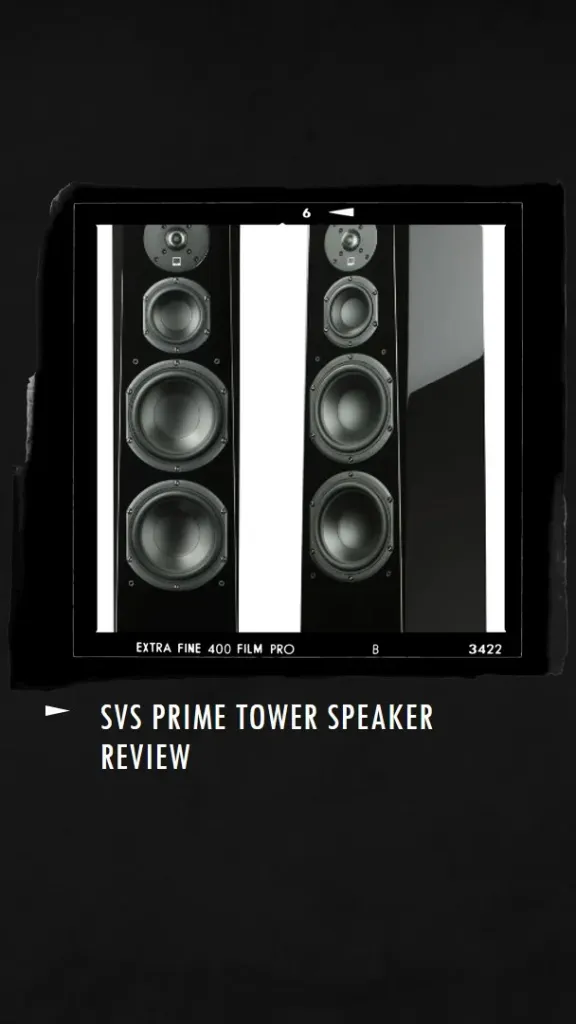
SVS is best known for subwoofers, but its Prime Tower has long been a popular choice for people who want a well-balanced 3-way tower at a mid-range price — and an easy match for an SVS sub.
This research-based review replaces our earlier version, which described the Prime as being in its “third iteration” and made listening claims we can’t substantiate. Retailers still list the Prime Tower as of our latest check; confirm availability before buying.
How we researched this: This guide is based on manufacturer specifications, owner documentation, published third-party measurements and professional reviews. We have not hands-on tested these speakers unless a section says so. Our methodology
Design and drivers
- 1-inch aluminum dome tweeter for treble.
- 4.5-inch midrange dedicated to the vocal range.
- Two 6.5-inch woofers for bass, in a ported cabinet.
- Finishes: black ash and piano gloss black have been offered.
A dedicated midrange means the woofers don’t have to handle vocals, which can reduce distortion at higher volume. See 2-way vs 3-way speakers.
Who it suits
- Medium-sized rooms, mixed music and movie use.
- Buyers planning to add an SVS subwoofer.
- People who want a true 3-way without premium pricing.
Because it’s ported, give it some space from the wall behind — start around 2 feet and adjust by ear.
Pairing with a subwoofer
SVS designed the Prime series to integrate with its subwoofers. Set your receiver’s crossover around 80 Hz as a starting point.
A compact sealed 12 in. subwoofer with a 325 W RMS amplifier and app control — tidy and tight-sounding in smaller rooms.
Pros and cons
Pros
- True 3-way design with dedicated midrange.
- Well regarded by professional reviewers for value.
- Natural partner for SVS subwoofers.
Cons
- Ported cabinet needs some wall clearance.
- Availability through retailers varies.
- Sold individually.
Alternatives
ELAC Debut 3.0 DF63
The larger Debut 3.0 tower: a 3-way with 6.5 in. drivers and 31 Hz (−6 dB) extension in a slim 7.7 in. cabinet.
- True 3-way with dedicated midrange
- 31 Hz rated extension (−6 dB)
- Slim cabinet with outriggers and spikes
- Design3-way passive
- Drivers1 in. aluminum dome tweeter, 1x 6.5 in. aramid-fiber midrange, 2x 6.5 in. aramid-fiber woofers
- Sensitivity87.5 dB (2.83V)
- Impedance4–6 Ω (sources differ; min 3.6 Ω)
KEF Q7 Meta
KEF’s Uni-Q point-source driver with Metamaterial Absorption Technology aims for precise imaging; a port bung helps in smaller rooms.
- Uni-Q coincident driver for even dispersion
- Response quoted ±3 dB (46 Hz–20 kHz)
- Port bung included for near-wall use
- Design3-way passive
- DriversUni-Q array (0.75 in. vented aluminum dome tweeter with MAT + 4 in. aluminum midrange cone), 2x 6.5 in. hybrid aluminum bass cones
- Sensitivity87 dB (2.83V)
- Impedance4 Ω nominal (3.2 Ω min)
Yamaha NS-555
A 3-way tower with waveguide-loaded tweeter and midrange, designed as a natural partner for Yamaha AV receivers.
- True 3-way with waveguides
- 35 Hz rated extension
- Bi-wiring terminals
- Design3-way passive
- Drivers1 in. aluminum dome tweeter with waveguide horn, 5 in. cone midrange with waveguide horn, 2x 6.5 in. PMD cone woofers
- Sensitivity88 dB (2.83V)
- Impedance6 Ω nominal
Check the Prime Tower’s current listing: SVS Prime Tower on Amazon
How the Prime Tower fits a home theater
As front left/right speakers, the Prime Towers pair naturally with SVS’s Prime center channel for consistent dialogue as voices move across the screen. Add an SVS subwoofer and let the receiver’s bass management handle the low end; 80 Hz is a common starting crossover. For surround channels, smaller Prime bookshelf or satellite models keep the tonal character consistent.
Who should look elsewhere
- Very small rooms where a slim 2-way or bookshelf speakers would fit better.
- Listeners who want maximum efficiency for low-power amplifiers — Klipsch horn-loaded towers are easier to drive.
- Buyers who need a warranty-backed purchase but can only find used units.
Frequently asked questions
Is the SVS Prime Tower still available?
Retailers still listed it at our latest check. Confirm availability and finish before buying.
Is the SVS Prime Tower good for home theater?
Yes — its 3-way design and SVS subwoofer integration make it a natural front speaker for home theater.
Does it need a subwoofer?
Not for most music, but movies benefit from a sub handling the LFE channel.
Related guides: KEF Q750 vs SVS Prime Tower · Best 3-way towers · Under $1,000
Leave a Reply