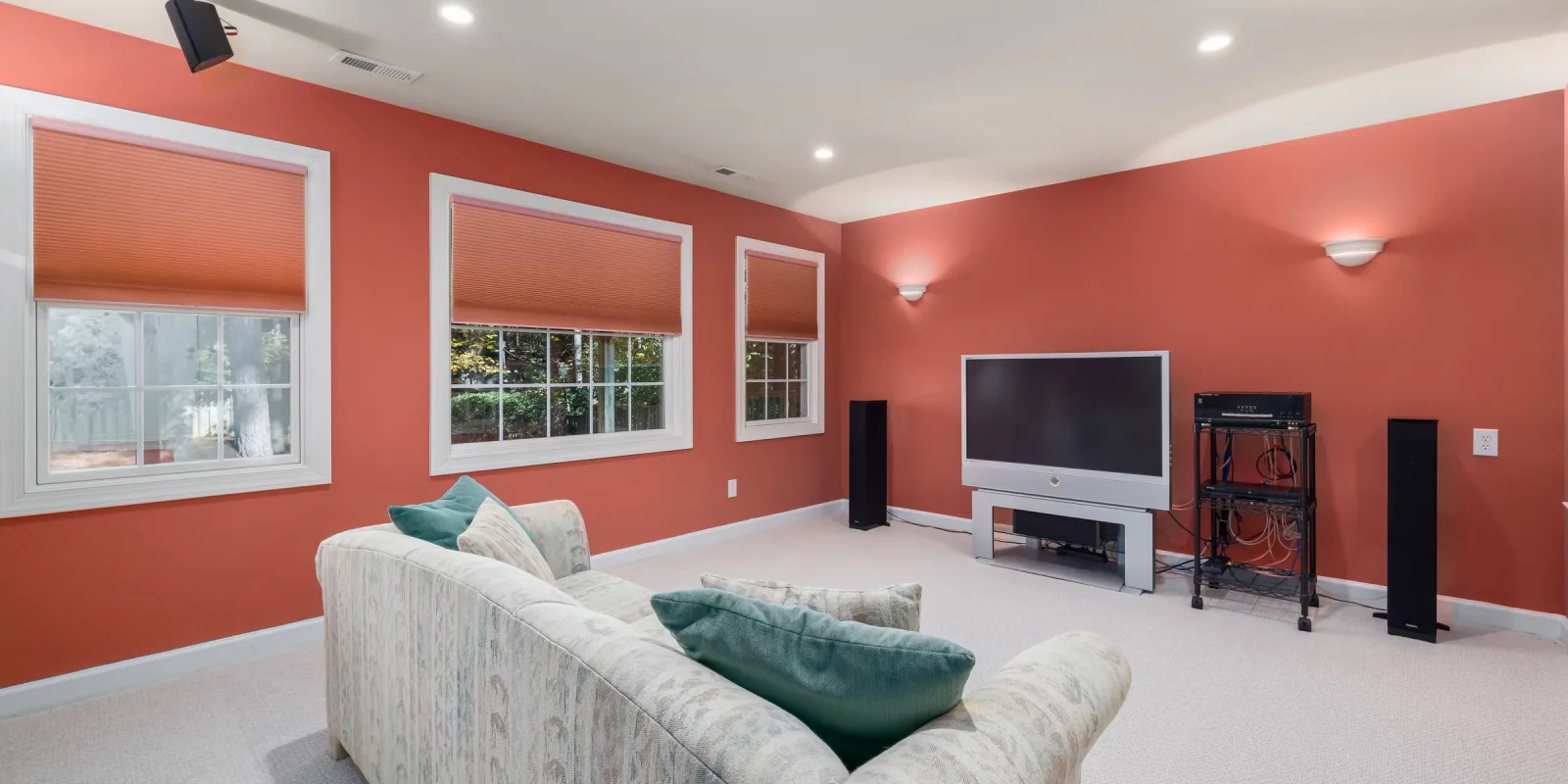
In a home theater, the question isn’t just “tower or bookshelf?” — it’s which speaker goes where. Many great systems use both: towers for the front left and right, bookshelf speakers for the surrounds, and a subwoofer underneath it all.
This article was originally published under this address with home-theater speaker advice. We’ve rewritten it as a focused guide to using floor-standing and bookshelf speakers in a surround system. For the general music-listening comparison, see floor-standing vs bookshelf speakers, and for satellites, floor-standing vs satellite speakers.
Front left and right: where towers shine
The front speakers carry most of the soundtrack’s music and effects. Towers’ larger cabinets and extra woofers give them more headroom for explosions and orchestral swells, and more bass when the subwoofer crosses over. High-sensitivity towers also make life easier for AV receivers, which often deliver less power per channel when all channels are driven.
JBL Stage 280F
Dual 8 in. woofers, a waveguide tweeter and 91 dB sensitivity give the Stage 280F big-room output for movies at a mid-range price.
- Dual 8 in. woofers; 33 Hz (±6 dB)
- 91 dB sensitivity is easy to drive
- Atmos module binding posts
- Design2.5-way passive
- Drivers1 in. anodized aluminum tweeter in HDI waveguide, 2x 8 in. polycellulose ribbed-cone woofers
- Sensitivity91 dB (2.83V)
- Impedance6 Ω nominal
Klipsch Reference R-800F
The larger Reference tower adds dual 8 in. woofers for deeper bass (34 Hz ±3 dB) with the same easy 8-ohm, high-efficiency design.
- Dual 8 in. woofers
- Very easy to drive (98 dB in-room rating)
- 8 Ω load suits AV receivers
- Design2-way passive, horn tweeter
- Drivers1 in. aluminum LTS tweeter on 90x90 Tractrix horn, 2x 8 in. spun-copper TCP woofers
- Sensitivity98 dB (2.83V, in-room)
- Impedance8 Ω nominal
Polk Audio Signature Elite ES60
Three 6.5 in. woofers, 90 dB sensitivity and 32 Hz rated extension make this a versatile, easy-to-drive tower for music and movies in medium to large rooms.
- 90 dB (2.83V) sensitivity plays loud on modest power
- Three woofers for bass weight and output
- Widely available in the US
- DesignPassive, 4 drivers (3 woofers)
- Drivers1 in. Terylene dome tweeter, 3x 6.5 in. mica-reinforced polypropylene woofers
- Sensitivity90 dB (2.83V)
- Impedance4–8 Ω amp compatible
Surrounds: where bookshelf speakers shine
Surround channels mostly carry ambience and effects, so they don’t need tower-sized cabinets. Bookshelf speakers on stands or wall brackets at or slightly above ear height are the usual choice — compact and easy to place beside or behind the seating. Rear floor-standing speakers can work too, if space allows: see floor-standing speakers for rear surround sound.
Small rooms: bookshelf fronts + subwoofer
In small rooms, towers can overload the bass and crowd the screen wall. Bookshelf fronts with a well-placed subwoofer often sound tighter. Set the receiver’s speakers to “Small” with an 80 Hz crossover as a starting point.
Matching matters most
Dialogue moves between the left, center and right speakers. If they come from different families, voices change character as they pan. Choose the center channel from the same series as your front towers whenever possible.
Receiver setup checklist
- Run the receiver’s room correction (Audyssey, YPAO, etc.).
- Check speaker sizes and crossover — 80 Hz is a common starting point.
- Confirm distances and levels, then adjust the subwoofer level by ear.
A 7.2-channel 8K receiver with Audyssey room correction and HEOS streaming — a capable hub for tower speakers in a home theater.
Frequently asked questions
Should front speakers be towers or bookshelf speakers?
In medium and large rooms, towers usually perform better as fronts. In small rooms, bookshelf speakers with a subwoofer are often the better fit.
Can I use towers as surround speakers?
Yes, if you have space. They add weight to surround effects, though most systems use bookshelf or satellite speakers for surrounds.
Do I still need a subwoofer with tower fronts?
For movies, it’s strongly recommended — the LFE channel is designed for a subwoofer. For music, good towers may be enough.
Related guides: Best tower speakers for home theater · Tower vs bookshelf speakers · Do tower speakers need a subwoofer?
Leave a Reply