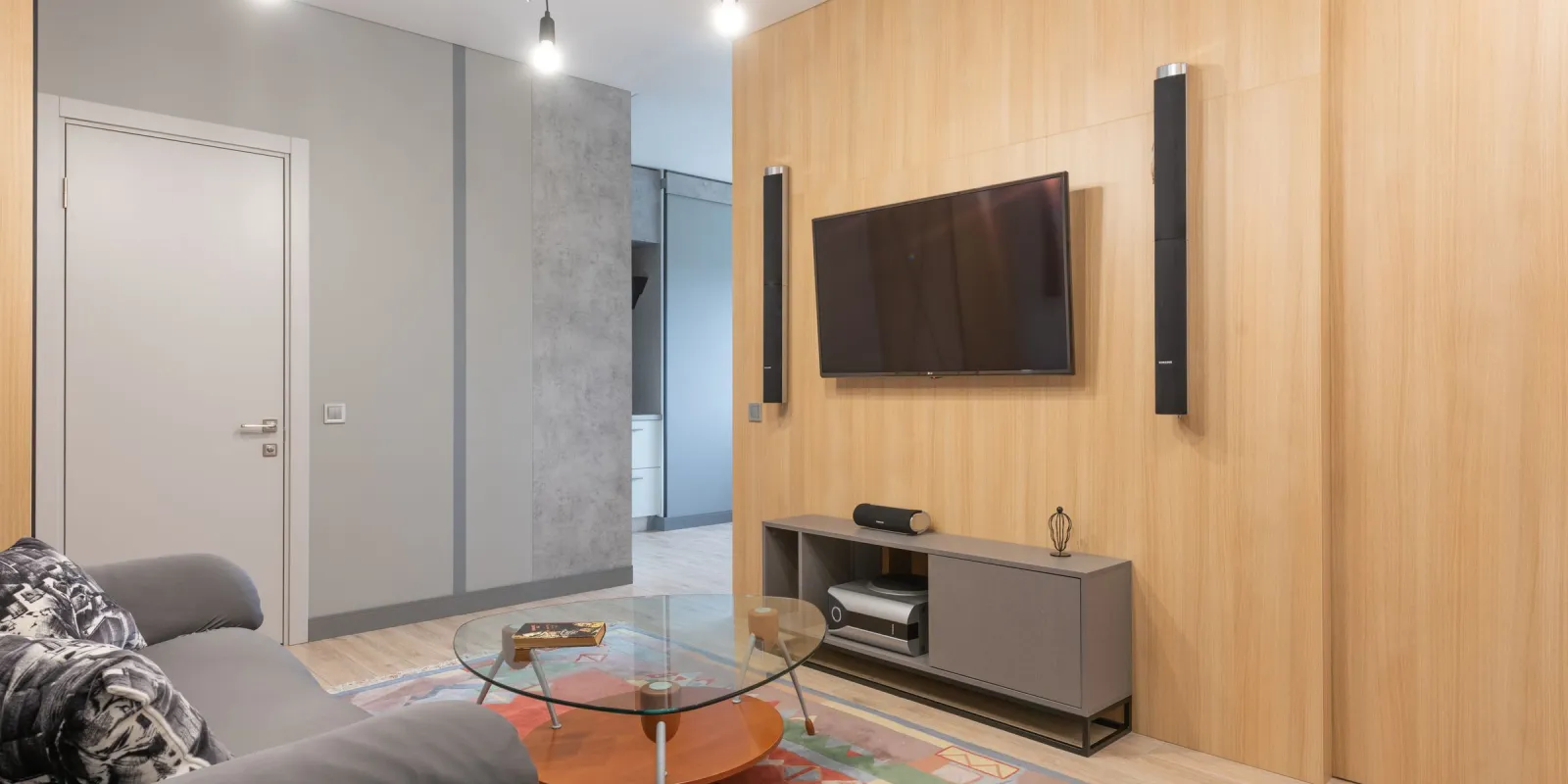
Floor-standing speakers don’t have to dominate a room. Slim towers use narrow cabinets — often under 8 inches wide — to deliver more bass and volume than bookshelf speakers while taking up little visual space.
Our original guide featured products that are no longer sold (and, confusingly, a soundbar). We’ve rebuilt it around current slim towers, with dimensions from manufacturer documentation.
How we researched this: This guide is based on manufacturer specifications, owner documentation, published third-party measurements and professional reviews. We have not hands-on tested these speakers unless a section says so. Our methodology
Why choose a slim tower?
- Small footprint — often no more floor space than a bookshelf speaker on a stand.
- Less visual bulk beside a TV.
- More bass than equivalent bookshelf speakers, because tall cabinets add internal volume.
The trade-off: narrow cabinets limit woofer size, so slim towers usually use multiple small woofers (5–6.5 inch) and may need a subwoofer for deep movie bass.
Our slim tower picks
Slimmest 3-way: ELAC Debut 3.0 DF53
ELAC Debut 3.0 DF53
A very slim (6.8 in. wide) 3-way tower from ELAC’s latest Debut range — a tidy fit for smaller rooms.
- Design3-way passive
- Drivers1 in. aluminum dome tweeter, 1x 5.25 in. aramid-fiber midrange, 2x 5.25 in. aramid-fiber woofers
- Frequency response38 Hz–38 kHz (-6 dB)
- Sensitivity87.5 dB (2.83V)
- Impedance4–6 Ω (sources differ; min 4.2 Ω)
- Amp power30-150 W
- Dimensions40.6 × 6.8 × 9.7 in. (H×W×D)
- Weight34.6 lb
Advantages
- True 3-way design in a 6.8 in. wide cabinet
- Outrigger feet and spikes included
- Magnetic grilles
Limitations
- ELAC sources differ on nominal impedance (4 vs 6 Ω)
- Response quoted at −6 dB (looser tolerance)
- Small 5.25 in. woofers
Best for small rooms: Wharfedale Diamond 12.3
Wharfedale Diamond 12.3
A slim 7.1 in. wide 2.5-way tower with an easy 8-ohm-compatible load — a natural fit for smaller rooms and modest stereo amplifiers.
- Design2.5-way passive
- Drivers1 in. (25 mm) textile dome tweeter, 5 in. (130 mm) mid/bass, 5 in. (130 mm) bass (Klarity PP cones)
- Frequency response45 Hz–20 kHz +/- 3 dB (40 Hz at -6 dB)
- Sensitivity89 dB (2.83V)
- Impedance8 Ω nominal (5.0 Ω min)
- Amp power30-150 W
- Dimensions38.4 × 7.1 × 13.7 in. (H×W×D)
- Weight43.0 lb
Advantages
- Slim cabinet suits smaller rooms
- Easy load: 8 Ω compatible, 5 Ω minimum
- Response quoted ±3 dB (45 Hz–20 kHz)
Limitations
- Smaller 5 in. drivers limit deep bass
- Port location not documented
- Pair/single status — check listing
Best budget slim tower: Polk Monitor XT60
Polk Audio Monitor XT60
A slim, light entry-level tower that uses passive bass radiators instead of a port — an easy, affordable first step up from bookshelf speakers.
- Design2-way passive
- Drivers1 in. Terylene dome tweeter, 1x 6.5 in. bi-laminate paper woofer, 2x 6.5 in. passive bass radiators
- Frequency response38 Hz–40 kHz
- Sensitivity86 dB (1W)
- Impedance4–8 Ω amp compatible
- Amp power25-200 W per channel
- Dimensions36.4 × 7.5 × 9.09 in. (H×W×D)
- Weight20 lb
Advantages
- Slim 7.5 in. wide cabinet is easy to fit
- Passive radiators instead of a port ease near-wall placement
- Wide 25–200 W amplifier range
Limitations
- 86 dB (1W) sensitivity needs some amplifier headroom
- No published nominal impedance
- Sold individually — buy two
Premium slim tower: KEF Q11 Meta
KEF Q11 Meta
The flagship Q Meta adds a third bass driver for more output and authority in larger rooms.
- Design3-way passive
- DriversUni-Q array (0.75 in. vented aluminum dome tweeter with MAT + 4 in. aluminum midrange cone), 3x 6.5 in. hybrid aluminum bass cones
- Frequency response44 Hz–20 kHz +/- 3 dB (37 Hz–20 kHz at -6 dB)
- Sensitivity89 dB (2.83V)
- Impedance4 Ω nominal (3.2 Ω min)
- Amp power15-225 W
- Dimensions41.8 × 8.3 × 15 in. (H×W×D)
- Weight49.6 lb
Advantages
- Three 6.5 in. bass drivers plus Uni-Q array
- 89 dB sensitivity
- Response quoted ±3 dB (44 Hz–20 kHz)
Limitations
- 4 Ω nominal (3.2 Ω min) needs a capable amp
- Sold individually
- Width with plinth not clearly published
Ultra-slim TV tower: Yamaha NS-F210
A very slim, light tower with tiny 3-1/8 in. woofers — best treated as a stylish TV speaker paired with a subwoofer.
Compare dimensions
| Product | Design | Dimensions | Sensitivity | Impedance | Best for | Amazon |
|---|---|---|---|---|---|---|
| ELAC Debut 3.0 DF53 | 3-way passive | 40.6 × 6.8 × 9.7 in. (H×W×D) | 87.5 dB (2.83V) | 4–6 Ω (sources differ; min 4.2 Ω) | Slim 3-way | View |
| Wharfedale Diamond 12.3 | 2.5-way passive | 38.4 × 7.1 × 13.7 in. (H×W×D) | 89 dB (2.83V) | 8 Ω nominal (5.0 Ω min) | Best for Small Rooms | View |
| Polk Audio Monitor XT60 | 2-way passive | 36.4 × 7.5 × 9.09 in. (H×W×D) | 86 dB (1W) | 4–8 Ω amp compatible | Best Budget | View |
| KEF Q11 Meta | 3-way passive | 41.8 × 8.3 × 15 in. (H×W×D) | 89 dB (2.83V) | 4 Ω nominal (3.2 Ω min) | Large-room Uni-Q | View |
| Yamaha NS-F210 | 2-way passive | 41.3 × 9.3 × 9.3 in. (H×W×D) | 86 dB (2.83V) | 6 Ω nominal | Slim TV tower (add a sub) | View |
Specifications are manufacturer-published figures. Measurement methods differ between brands, so treat small differences with caution.
Placement tips for slim towers
- Stability first: narrow towers can tip; use supplied outriggers or plinths, and keep children and pets in mind.
- Port position matters near walls: passive radiators (Polk XT60) and port bungs (KEF) make near-wall placement easier.
- Add a sub if you want deep movie bass — see do tower speakers need a subwoofer?
Slim towers vs bookshelf speakers on stands
A pair of bookshelf speakers on stands occupies a similar footprint to slim towers. The towers usually win on bass and output thanks to their larger internal volume and extra woofers, while bookshelf speakers can be easier to position precisely and cost less. If you plan to add a subwoofer anyway, either can work well; if you want full-range sound without a sub, slim towers are the better bet.
What to check before buying a slim tower
- Width and depth including outriggers, plinths or feet.
- Port position — rear, front, floor-firing or passive radiators.
- Impedance and sensitivity for your amplifier.
- Whether it’s sold individually or as a pair.
Frequently asked questions
Do slim tower speakers have good bass?
Better than similarly sized bookshelf speakers, thanks to their tall cabinets, but their small woofers limit the deepest bass. A subwoofer fills the gap for movies.
What's the slimmest good tower speaker?
Among current models we track, the ELAC Debut 3.0 DF53 (6.8 inches wide) and Wharfedale Diamond 12.3 (7.1 inches) are among the narrowest full-range towers. The Yamaha NS-F210 is slim too, but its tiny woofers need a subwoofer.
Are slim towers good for small rooms?
Often yes — they deliver tower-style sound without overwhelming the space. See best tower speakers for small rooms.
Related guides: Best tower speakers for small rooms · Placement checklist · Best tower speakers
Leave a Reply