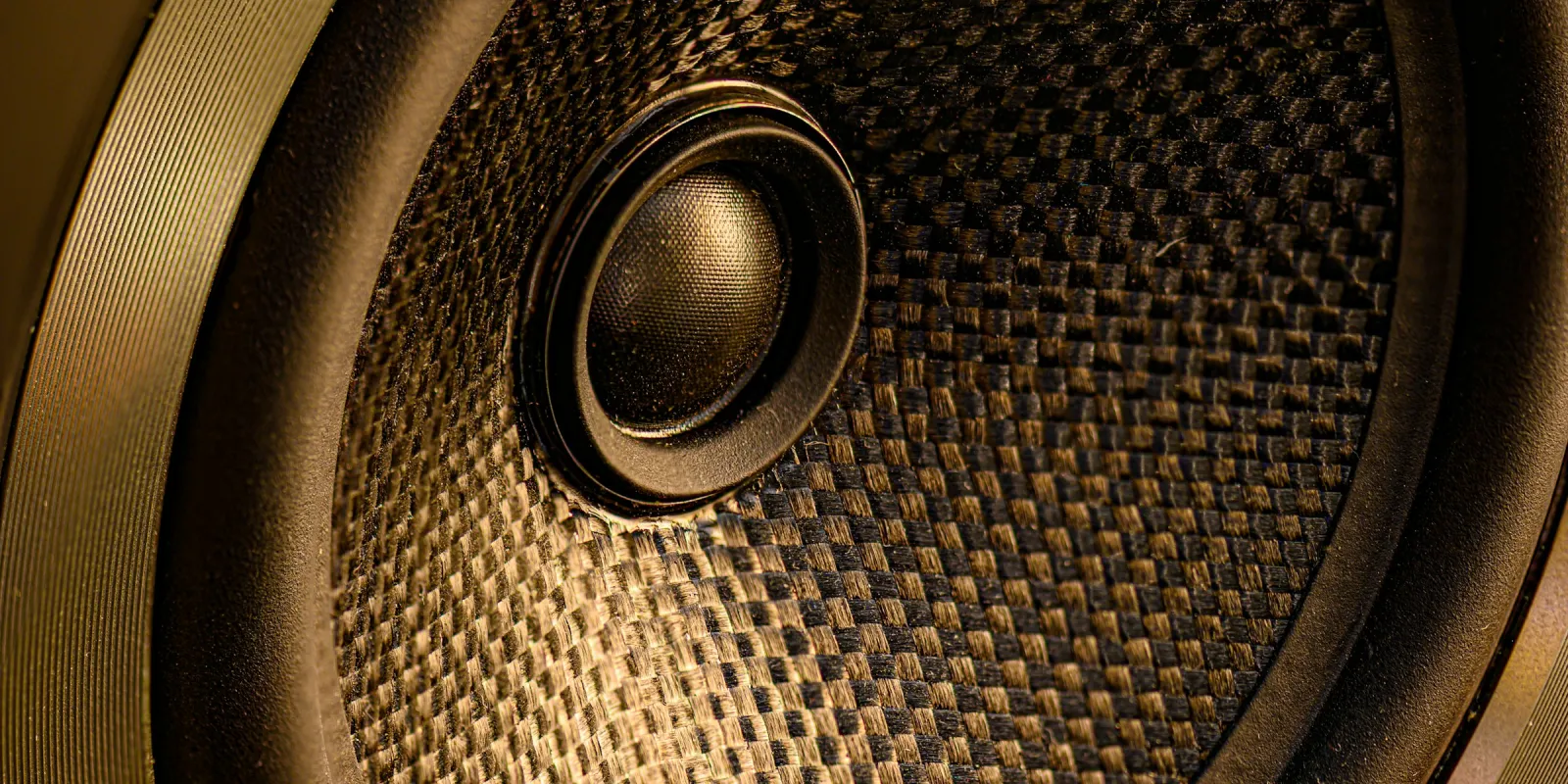
Polk Audio and Klipsch are two of the most popular tower speaker brands in the US, and they often end up on the same shortlist. But they approach speaker design very differently. Klipsch builds almost everything around a horn-loaded tweeter and high efficiency. Polk offers a wider spread of designs, from slim budget towers with passive radiators to premium 3-way models with floor-firing ports.
Neither brand is “better” overall. The right choice depends on your room, your amplifier, how close your speakers must sit to a wall, and the kind of sound you like. This guide compares the two brands tier by tier, using manufacturer specifications.
How we researched this: This guide is based on manufacturer specifications, owner documentation, published third-party measurements and professional reviews. We have not hands-on tested these speakers unless a section says so. Our methodology
How this comparison was made: we have not tested these speakers hands-on. This comparison is based on manufacturer specifications and documentation, plus our editorial analysis of what the designs imply. We did not rely on third-party listening impressions.
Two design philosophies, as the specs show them
Klipsch: horns and efficiency
Every Klipsch tower in our catalogue uses a 1-inch tweeter on a Tractrix horn, 8-ohm nominal impedance and rear-firing Tractrix ports. A horn works like a megaphone, coupling the tweeter to the air more efficiently and steering sound toward the listener. The result is very high sensitivity: Klipsch rates its Reference and Reference Premiere towers at 96–98 dB.
The caveat: Klipsch quotes sensitivity in-room (half-space), while most brands use the conventional full-space 2.83 V/1 m method (Polk quotes 2.83 V on its Signature Elite and Reserve towers, and 1W/1m on Monitor XT). Klipsch’s method reads several dB higher for the same speaker. So a 96 dB Klipsch isn’t 6 dB more efficient than a 90 dB Polk; the true gap is smaller. Klipsch towers are still genuinely easy to drive, but compare the numbers with care. Read more in speaker sensitivity explained.
Polk: a broad range of approaches
Polk’s towers vary much more from series to series:
- Monitor XT (entry level): Terylene dome tweeters and passive bass radiators instead of ports. Sensitivity is quoted at 1W/1m, and Polk publishes no nominal impedance, only “compatible with 4 and 8 ohm outputs”.
- Signature Elite (mid-range): Terylene dome tweeter, three 6.5-inch woofers and Polk’s Power Port (location not stated in Polk’s spec table), rated 90 dB at 2.83 V.
- Reserve (premium): Pinnacle Ring Radiator tweeters, Turbine Cone drivers and floor-firing Power Ports, with responses quoted at −3 dB and published minimum impedances.
In short, Klipsch offers one strong, consistent sonic identity. Polk offers more variety, with dome or ring-radiator tweeters that typically disperse sound more widely than a horn.
Entry tier: Polk Monitor XT70 vs Klipsch R-600F
| Product | Design | Drivers | Frequency response | Sensitivity | Impedance | Dimensions | Sold as | Best for | Amazon |
|---|---|---|---|---|---|---|---|---|---|
| Polk Audio Monitor XT70 | 2-way passive | 1 in. Terylene dome tweeter, 2x 6.5 in. bi-laminate paper woofers, 2x 8 in. passive bass radiators (front array) | 35 Hz–40 kHz | 89 dB (1W) | 4–8 Ω amp compatible | 40.4 × 9.25 × 12.5 in. (H×W×D) | Single speaker | Best Under $500 | View |
| Klipsch Reference R-600F | 2-way passive, horn tweeter | 1 in. aluminum LTS tweeter on 90x90 Tractrix horn, 2x 6.5 in. spun-copper TCP woofers | 38 Hz–21 kHz +/- 3 dB | 96 dB (2.83V, in-room) | 8 Ω nominal | 40 × 9.4 × 15.2 in. (H×W×D) | Check listing | High-efficiency value | View |
Specifications are manufacturer-published figures. Measurement methods differ between brands, so treat small differences with caution.
These two often compete for buyers stepping up from bookshelf speakers, although the R-600F generally sits in a higher price tier than the XT70.
- Bass loading: the XT70 uses two 8-inch passive radiators on the front baffle, so it doesn’t rely on space behind it. The R-600F uses rear-firing ports and needs wall clearance.
- Efficiency: XT70 89 dB (1W) vs R-600F 96 dB (in-room). Two different methods, so the real gap is smaller than 7 dB, but the Klipsch is the easier speaker to drive.
- Impedance: Klipsch states 8 ohms nominal; Polk publishes no nominal figure.
- Response: Klipsch quotes 38 Hz–21 kHz ±3 dB. Polk quotes 35 Hz–40 kHz with no tolerance, so the deeper number isn’t necessarily deeper bass.
- Size: the XT70 is lighter (35 vs 41 lb) and shallower (12.5 vs 15.2 in.).
Our read: the XT70 is the easier fit for tight spaces and budgets; the R-600F is the more dynamic, efficient option if you have room behind it. For a deeper look at Polk’s entry level, see our Polk Monitor XT60 review.
Mid tier: Polk Signature Elite ES60 vs Klipsch R-800F
| Product | Design | Drivers | Frequency response | Sensitivity | Impedance | Dimensions | Sold as | Best for | Amazon |
|---|---|---|---|---|---|---|---|---|---|
| Polk Audio Signature Elite ES60 | Passive, 4 drivers (3 woofers) | 1 in. Terylene dome tweeter, 3x 6.5 in. mica-reinforced polypropylene woofers | 32 Hz–40 kHz | 90 dB (2.83V) | 4–8 Ω amp compatible | 44.5 × 8.5 × 15.7 in. (H×W×D) | Single speaker | Best Overall | View |
| Klipsch Reference R-800F | 2-way passive, horn tweeter | 1 in. aluminum LTS tweeter on 90x90 Tractrix horn, 2x 8 in. spun-copper TCP woofers | 34 Hz–21 kHz +/- 3 dB | 98 dB (2.83V, in-room) | 8 Ω nominal | 43 × 10.9 × 17.5 in. (H×W×D) | Check listing | Home theater value | View |
Specifications are manufacturer-published figures. Measurement methods differ between brands, so treat small differences with caution.
This is the most common head-to-head: two large, mainstream towers aimed at medium-to-large rooms.
- Drivers: the ES60 has three 6.5-inch mica-reinforced polypropylene woofers; the R-800F has two 8-inch spun-copper woofers. Both offer plenty of cone area.
- Tweeter: Terylene dome (Polk) vs aluminum LTS tweeter on a 90° × 90° Tractrix horn (Klipsch). Expect a wider, more relaxed spread from the dome on paper, and more focused, forward treble from the horn.
- Efficiency: ES60 90 dB (2.83 V) vs R-800F 98 dB (in-room). The Klipsch remains more efficient once you account for the method, but not by 8 dB.
- Response: ES60 32 Hz–40 kHz (no tolerance) vs R-800F 34 Hz–21 kHz ±3 dB. Only Klipsch’s figure tells you how flat the response is.
- Amplifier: Polk recommends 50–300 W per channel; Klipsch quotes 150 W continuous power handling and an 8-ohm load.
- Size: the ES60 is taller (44.5 vs 43 in.) but narrower (8.5 vs 10.9 in.) and shallower (15.7 vs 17.5 in.).
Our read: the R-800F suits movie-focused rooms where it can stand clear of the wall. The ES60 is the slimmer, more conventional all-rounder. Our Klipsch R-800F review covers the Klipsch in more detail.
Premium tier: Polk Reserve R600/R700 vs Klipsch RP-6000F II/RP-8000F II
| Product | Design | Drivers | Frequency response | Sensitivity | Impedance | Dimensions | Sold as | Best for | Amazon |
|---|---|---|---|---|---|---|---|---|---|
| Polk Audio Reserve R600 | 2-way passive | 1 in. Pinnacle Ring Radiator tweeter, 2x 6.5 in. Turbine Cone woofers | 43 Hz–38 kHz (-3 dB); 32 Hz–50 kHz overall | 87.5 dB (2.83V) | 4.0 Ω minimum | 41.9 × 11.1 × 15.0 in. (H×W×D) | Single speaker | Premium compact tower | View |
| Polk Audio Reserve R700 | 3-way passive | 1 in. Pinnacle Ring Radiator tweeter, 1x 6.5 in. Turbine Cone midrange, 2x 8 in. polypropylene woofers | 38 Hz–38 kHz (-3 dB); 30 Hz–50 kHz overall | 88 dB (2.83V) | 3.6 Ω minimum | 45.0 × 12.6 × 16.9 in. (H×W×D) | Single speaker | Premium 3-way | View |
| Klipsch RP-6000F II | 2-way passive, horn tweeter | 1 in. titanium LTS vented tweeter on hybrid Tractrix horn, 2x 6.5 in. Cerametallic woofers | 38 Hz–25 kHz +/- 3 dB | 96 dB (2.83V, in-room) | 8 Ω nominal | 39.6 × 9.29 × 17.57 in. (H×W×D) | Check listing | Premium efficiency | View |
| Klipsch RP-8000F II | 2-way passive, horn tweeter | 1 in. titanium LTS vented tweeter on hybrid Tractrix horn, 2x 8 in. Cerametallic woofers | 35 Hz–25 kHz +/- 3 dB | 98 dB (2.83V, in-room) | 8 Ω nominal | 43.1 × 10.84 × 18.25 in. (H×W×D) | Check listing | Best for Large Rooms | View |
Specifications are manufacturer-published figures. Measurement methods differ between brands, so treat small differences with caution.
At the premium level, the brands diverge most clearly.
Polk Reserve
- Pinnacle Ring Radiator tweeters and floor-firing Power Ports on both models.
- The R600 is a 2-way with two 6.5-inch woofers, 87.5 dB (2.83 V) and a 4.0-ohm minimum.
- The R700 is a true 3-way with a sealed 6.5-inch midrange and two 8-inch woofers, 88 dB and a 3.6-ohm minimum.
- Responses are quoted at −3 dB (43 Hz–38 kHz for the R600; 38 Hz–38 kHz for the R700).
Klipsch Reference Premiere
- Titanium LTS vented tweeters on hybrid Tractrix horns, with Cerametallic woofers.
- RP-6000F II: two 6.5-inch woofers, 96 dB in-room, 38 Hz–25 kHz ±3 dB.
- RP-8000F II: two 8-inch woofers, 98 dB in-room, 35 Hz–25 kHz ±3 dB.
- Both 8 ohms nominal, with rear-firing dual-chamber Tractrix ports and bi-wire/bi-amp terminals.
Our read: the Reserve models need a stronger, 4-ohm-capable amplifier but are easier to place near a wall thanks to floor-firing ports. The R700 is the only true 3-way in this comparison. The Reference Premiere towers are much easier to drive but need more space behind them and are deep (17.6–18.3 in.).
Amplifier pairing: where Klipsch has the edge
If you own an entry-level AV receiver, Klipsch is the safer choice. Its towers present an 8-ohm nominal load and are highly efficient, so modest power goes a long way. As a rule of thumb, every 3 dB of extra sensitivity halves the amplifier power needed for the same volume.
Polk is more varied:
- Monitor XT and Signature Elite: no published nominal impedance; Polk says they’re compatible with 4- and 8-ohm outputs. Any receiver rated for 4-ohm loads is a safe match.
- Reserve: published minimums of 4.0 ohms (R600) and 3.6 ohms (R700). Choose an amplifier that specifies output into 4 ohms, and expect to use more power than with Klipsch.
Check your amp with our amplifier compatibility checker or read what amplifier you need for tower speakers.
Placement: rear ports vs floor-firing ports and passive radiators
This is the most practical difference between the brands.
- Klipsch (all towers here): rear-firing Tractrix ports. The wall behind the speaker becomes part of the bass system, so placing them too close can make bass boomy. Plan for a couple of feet of clearance as a starting point.
- Polk Monitor XT: passive radiators, no port. The XT70’s radiators are on the front baffle. Less sensitive to wall distance.
- Polk Reserve: floor-firing Power Ports. The port fires into the gap between the speaker and the floor, so rear-wall distance matters less.
- Polk Signature Elite: uses a Power Port, but Polk’s spec table doesn’t state its location. Check product photos before assuming it suits near-wall placement.
If your speakers must sit near a wall or in a bookcase-lined alcove, Polk’s front-radiator and floor-firing designs are the easier fit. Our guide to positioning floorstanding speakers covers the details.
Which brand suits whom?
Klipsch suits you if…
- You’re building a home theater and want high output from an ordinary receiver
- You enjoy a lively, forward, dynamic sound
- Your room lets the speakers stand away from the wall
- You like the idea of low-power amplifiers, including tube amps
Polk suits you if…
- You need a slim, light or shallow tower for a smaller space
- Your speakers must sit close to a wall
- You prefer a dome or ring-radiator tweeter’s wider, gentler presentation
- You want a true 3-way at the premium level (Reserve R700)
- You’re on a tight budget (Monitor XT60/XT70)
Verdict
Klipsch is the specialist: a consistent horn-based design, 8-ohm loads and very high efficiency, best for home theater and for anyone with a modest amplifier and space behind the speakers. Just remember its in-room sensitivity ratings flatter it compared with other brands.
Polk is the generalist: a wider range of sizes, tweeter types and bass-loading methods, with the edge for small rooms, near-wall placement and buyers who prefer a softer treble. At the premium end, it asks more of your amplifier.
If you’re still undecided, try our speaker match finder, which weighs your room, amp and listening habits.
Frequently asked questions
Is Polk or Klipsch better for home theater?
On paper, Klipsch has an advantage for home theater: its horn tweeters and 8-ohm loads deliver high volume from ordinary AV receivers. Polk also builds strong home theater towers, especially the Signature Elite ES60, and its designs are often easier to place near a wall. Room layout and amplifier matter more than the badge.
Why are Klipsch sensitivity ratings so high?
Partly because horns are genuinely efficient, and partly because of how Klipsch measures. It quotes an in-room, half-space figure, which reads several dB higher than the full-space anechoic method most brands use. Klipsch towers are still easy to drive, but don’t compare their numbers directly with Polk’s.
Do Klipsch speakers sound harsh?
Horn tweeters tend to sound more forward and direct than dome tweeters, and some listeners find that fatiguing while others love the immediacy. It depends on taste, room acoustics and setup. Adjusting toe-in and placing the speakers properly can noticeably soften the treble. If possible, listen before buying.
Can I mix Polk and Klipsch speakers in one system?
You can, but it’s not ideal for the front three speakers. Different tweeters and voicing make sound pans across the front less seamless. If you mix brands, keep the front left, center and right from the same brand and series, and use the other brand for surrounds. Run your receiver’s room correction afterward.
Which brand is easier to place in a small room?
Polk, generally. Its Monitor XT towers use passive radiators instead of ports, and its Reserve towers use floor-firing ports, so both tolerate nearby walls better than Klipsch’s rear-firing ports. Polk’s slimmest towers are also narrower and shallower than Klipsch’s.
Related guides
For individual picks, see the best tower speakers and the best tower speakers for home theater. Our in-depth reviews of the Polk Monitor XT60 and Klipsch R-800F go further on each brand’s approach.

Leave a Reply