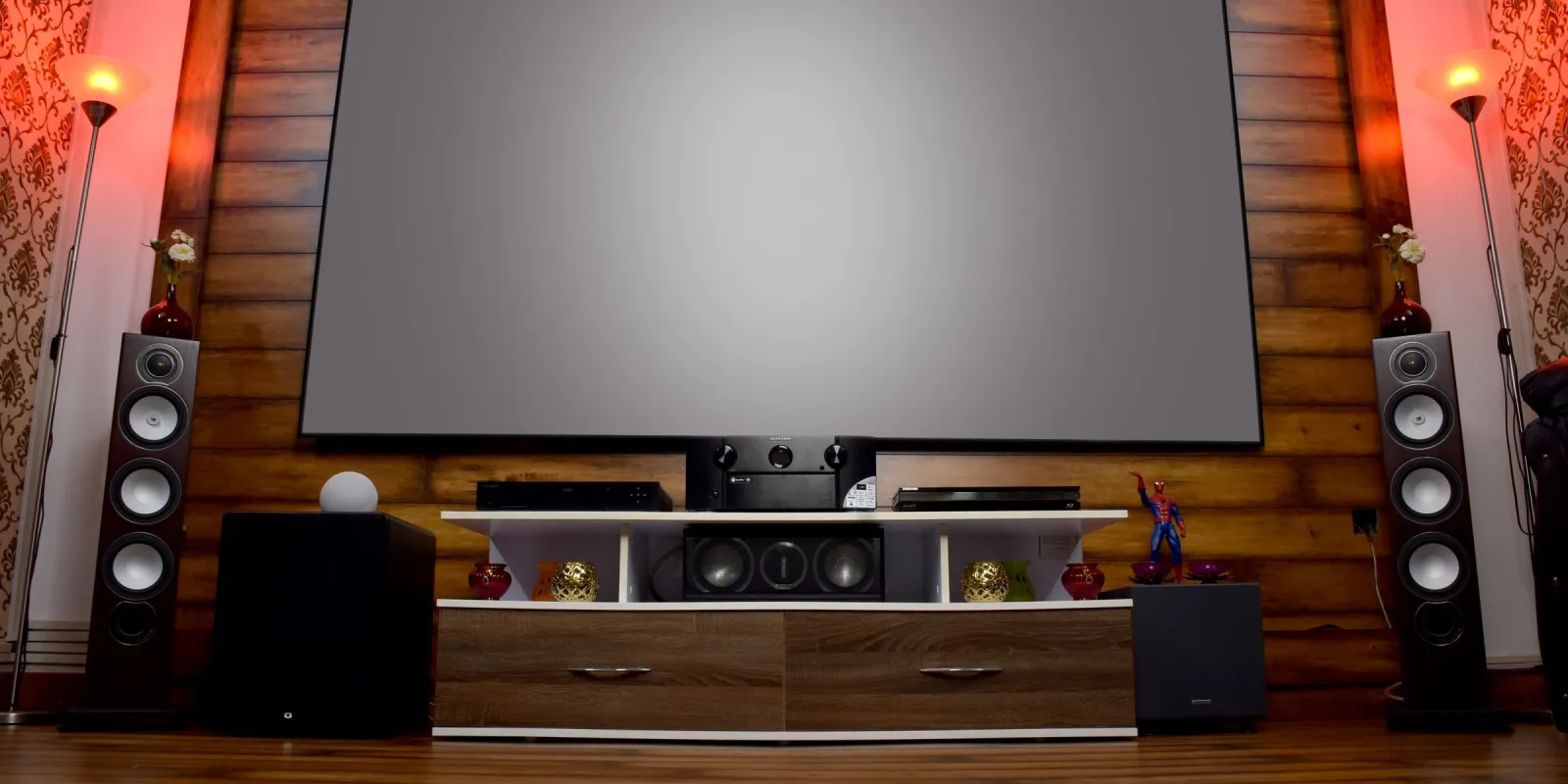
In a home theater, the front left and right speakers carry most of the music score, a lot of the effects and part of the dialogue. Tower speakers suit that job well. They have more cone area than bookshelf speakers, they sit at a sensible height without stands, and many of them are built to work with matching center channels and Dolby Atmos modules.
A good home theater tower is not simply the one with the deepest bass figure. It is easy for an AV receiver to drive, it belongs to a series with a matching center channel, and it fits your room. The picks below cover big dedicated theaters, mixed living rooms, and one tower with a powered subwoofer built in.
We have not tested these speakers ourselves. Every recommendation comes from manufacturer specifications and our own analysis of what those specs mean in a real room.
How we researched this: This guide is based on manufacturer specifications, owner documentation, published third-party measurements and professional reviews. We have not hands-on tested these speakers unless a section says so. Our methodology
What makes a tower good for home theater?
Four things on a spec sheet matter more for movies than for most music listening:
- Sensitivity. This is how loud a speaker plays from a given input (usually 2.83 volts at 1 meter). Higher numbers mean less amplifier power for the same volume, which helps with explosions and loud score peaks. As a rule, a 90 dB speaker needs half the power of an 87 dB speaker to reach the same level.
- An easy load. AV receivers drive five, seven or more channels from one power supply. A speaker with a benign impedance (6 to 8 ohms nominal) is easier on that supply than a 4-ohm design.
- A matching series. If the brand makes a center channel and surrounds from the same family, voices and effects sound consistent as they move around the room.
- Room fit. A rear port needs space from the wall. A deep cabinet needs floor space. Most home theaters live in real living rooms, so this matters.
Best overall for home theater: JBL Stage 280F
The JBL Stage 280F ticks the most home theater boxes on paper. It is a 2.5-way design. That means both 8 in. woofers play bass, but only one of them continues up into the midrange before handing off to the tweeter. JBL rates it at 91 dB sensitivity with a 6-ohm nominal impedance and a 20–225 W amplifier range. That is an easy match for any mainstream AV receiver. The 1 in. aluminum tweeter sits in JBL’s HDI waveguide, which is designed to control how sound spreads across a wide seating area.
For theater builders the key feature is the dedicated Atmos binding posts. JBL’s spec sheet says the 280F works with the Stage 240H height module, so you can add overhead effects later without new stands or ceiling holes. Two caveats. JBL quotes the 33 Hz–25 kHz frequency response at ±6 dB, a looser tolerance than the ±3 dB some rivals use, so don’t compare the 33 Hz figure directly with theirs. And the speaker uses rear-firing ports and a 14.1 in. wide base, so leave it some room. It is sold individually. Check current price on Amazon.
JBL Stage 280F
Dual 8 in. woofers, a waveguide tweeter and 91 dB sensitivity give the Stage 280F big-room output for movies at a mid-range price.
- Design2.5-way passive
- Drivers1 in. anodized aluminum tweeter in HDI waveguide, 2x 8 in. polycellulose ribbed-cone woofers
- Frequency response33 Hz–25 kHz +/- 6 dB
- Sensitivity91 dB (2.83V)
- Impedance6 Ω nominal
- Amp power20-225 W
- Dimensions43.8 × 14.1 × 16.5 in. (H×W×D)
- Weight55.2 lb
Advantages
- Dual 8 in. woofers; 33 Hz (±6 dB)
- 91 dB sensitivity is easy to drive
- Atmos module binding posts
Limitations
- Rear ports need wall clearance
- Wide 14.1 in. base
- ±6 dB response tolerance is loose
Best for large rooms and dedicated theaters: Klipsch RP-8000F II
If your theater is a big room, a basement or an open-plan space, the RP-8000F II makes sense. It pairs two 8 in. Cerametallic woofers with a titanium tweeter on a Tractrix horn. Horn-loaded tweeters are very efficient, and Klipsch rates the speaker at 98 dB. Klipsch measures sensitivity “in-room” (half-space), though, and that method reads several dB higher than the full-space figures most brands quote. Treat the RP-8000F II as very efficient, not as 7 dB louder than a 91 dB JBL.
The frequency response is quoted at 35 Hz–25 kHz ±3 dB, which is a tighter, more useful tolerance. The impedance is 8 ohms nominal, and power handling is rated at 150 W continuous. Klipsch lists bi-wire/bi-amp terminals with Dolby Atmos passthrough, which makes it easier to connect a matching Atmos elevation module. The trade-offs are size and placement: at 18.25 in. deep and 61.4 lb, it is a big cabinet, and its rear-firing ports want clear space behind them. Klipsch does not say whether it is sold singly or in pairs, so check the listing. View on Amazon.
Klipsch RP-8000F II
Dual 8 in. Cerametallic woofers and Klipsch’s highest efficiency make this a natural pick for big rooms and dedicated theaters.
- Design2-way passive, horn tweeter
- Drivers1 in. titanium LTS vented tweeter on hybrid Tractrix horn, 2x 8 in. Cerametallic woofers
- Frequency response35 Hz–25 kHz +/- 3 dB
- Sensitivity98 dB (2.83V, in-room)
- Impedance8 Ω nominal
- Dimensions43.1 × 10.84 × 18.25 in. (H×W×D)
- Weight61.4 lb
- Sold asCheck listing
Advantages
- Dual 8 in. woofers; 35 Hz (±3 dB)
- Very high efficiency for big rooms
- Atmos passthrough terminals
Limitations
- Large, heavy cabinet (61 lb, 18.25 in. deep)
- Rear ports need space
- In-room sensitivity rating not directly comparable
Best value: Klipsch R-800F
The R-800F is the Reference-series sibling of the RP-8000F II. It has the same basic recipe: two 8 in. woofers, a 1 in. horn-loaded tweeter and rear Tractrix ports. The cones and tweeter materials are simpler (spun-copper woofers and an aluminum tweeter). Klipsch quotes 34 Hz–21 kHz ±3 dB, 98 dB in-room sensitivity and an 8-ohm nominal load. That makes it one of the easiest towers here for an entry-level receiver to drive.
It suits buyers who want a lot of output and loudness per dollar. The horn sound is not to everyone’s taste, so if you can, listen to Klipsch speakers before you buy. Klipsch’s spec notes don’t mention Atmos connections on this model, so plan on separate height speakers if you want Atmos. Like its bigger sibling, it is deep (17.5 in.) and rear-ported. See available options.
Klipsch Reference R-800F
The larger Reference tower adds dual 8 in. woofers for deeper bass (34 Hz ±3 dB) with the same easy 8-ohm, high-efficiency design.
- Design2-way passive, horn tweeter
- Drivers1 in. aluminum LTS tweeter on 90x90 Tractrix horn, 2x 8 in. spun-copper TCP woofers
- Frequency response34 Hz–21 kHz +/- 3 dB
- Sensitivity98 dB (2.83V, in-room)
- Impedance8 Ω nominal
- Dimensions43 × 10.9 × 17.5 in. (H×W×D)
- Weight54 lb
- Sold asCheck listing
Advantages
- Dual 8 in. woofers
- Very easy to drive (98 dB in-room rating)
- 8 Ω load suits AV receivers
Limitations
- Rear ports need wall clearance
- Large 17.5 in. deep cabinet
- In-room sensitivity rating reads higher than others
Most versatile: Polk Signature Elite ES60
The ES60 is the pick for a living room that does movies on Friday and music on Sunday. Polk fits three 6.5 in. woofers and a 1 in. tweeter into a slim 8.5 in. wide cabinet. It rates the speaker at 90 dB (2.83 V), which is easy for an AV receiver. Polk’s spec table doesn’t state how many “ways” the design has. It lists a single 2.4 kHz crossover, and some retailers call it 3-way. Polk also gives no nominal impedance, only “compatible with 4 and 8 ohm outputs.”
On paper, the three woofers should help with output and bass weight. Polk lists 32 Hz–40 kHz but gives no tolerance, so treat the low-end figure loosely. The cabinet is 15.7 in. deep and uses Polk’s Power Port. Polk doesn’t state the port’s location, so plan some breathing room. The recommended amplifier range is 50–300 W, so it wants a receiver with some muscle for big rooms. It is sold individually. Check current availability.
Polk Audio Signature Elite ES60
Three 6.5 in. woofers, 90 dB sensitivity and 32 Hz rated extension make this a versatile, easy-to-drive tower for music and movies in medium to large rooms.
- DesignPassive, 4 drivers (3 woofers)
- Drivers1 in. Terylene dome tweeter, 3x 6.5 in. mica-reinforced polypropylene woofers
- Frequency response32 Hz–40 kHz
- Sensitivity90 dB (2.83V)
- Impedance4–8 Ω amp compatible
- Amp power50-300 W per channel
- Dimensions44.5 × 8.5 × 15.7 in. (H×W×D)
- Weight52 lb
Advantages
- 90 dB (2.83V) sensitivity plays loud on modest power
- Three woofers for bass weight and output
- Widely available in the US
Limitations
- Deep 15.7 in. cabinet needs floor space
- Frequency response tolerance not published
- Sold individually
Premium pick: KEF Q11 Meta
The Q11 Meta is the flagship of KEF’s Q Meta range, and it suits buyers who care about accuracy as much as scale. It is a true 3-way. KEF’s Uni-Q driver places a 0.75 in. tweeter at the center of a 4 in. midrange cone, so both radiate from the same point. Below it are three 6.5 in. bass cones. A point-source design like this aims for consistent sound across a wide seating area, which helps dialogue and effects stay stable for people who are not in the center seat.
KEF quotes 44 Hz–20 kHz ±3 dB (37 Hz at −6 dB) and 89 dB sensitivity. The one real caution is the load: 4 ohms nominal with a 3.2-ohm minimum. That is harder work for a budget AV receiver driving several channels. Check that your receiver supports 4-ohm speakers, or plan to add a power amp later. KEF’s dimension figures also look inconsistent (the listed width may exclude the plinth), so measure your space with a margin. It is sold individually. Explore on Amazon.
KEF Q11 Meta
The flagship Q Meta adds a third bass driver for more output and authority in larger rooms.
- Design3-way passive
- DriversUni-Q array (0.75 in. vented aluminum dome tweeter with MAT + 4 in. aluminum midrange cone), 3x 6.5 in. hybrid aluminum bass cones
- Frequency response44 Hz–20 kHz +/- 3 dB (37 Hz–20 kHz at -6 dB)
- Sensitivity89 dB (2.83V)
- Impedance4 Ω nominal (3.2 Ω min)
- Amp power15-225 W
- Dimensions41.8 × 8.3 × 15 in. (H×W×D)
- Weight49.6 lb
Advantages
- Three 6.5 in. bass drivers plus Uni-Q array
- 89 dB sensitivity
- Response quoted ±3 dB (44 Hz–20 kHz)
Limitations
- 4 Ω nominal (3.2 Ω min) needs a capable amp
- Sold individually
- Width with plinth not clearly published
Built-in powered subwoofer: Definitive Technology Dymension DM70
The DM70 takes a different approach. Each tower contains a powered 10 in. subwoofer, which plugs into the wall, and two 10 in. passive radiators. Your amplifier drives only the tweeters and midrange drivers. The design is bipolar: drivers face both forward and backward, with two tweeters and four 5.25 in. midrange/midbass drivers in total. That spreads sound around the room for a more diffuse, enveloping presentation.
Definitive quotes 30 Hz–23 kHz at −3 dB, which is the deepest tightly toleranced figure in this list, plus 90 dB sensitivity and a 4-ohm nominal (8-ohm compatible) rating. A bass level control (+12/−15 dB) and a rear tweeter switch (0/−6 dB) help you tune it to the room. The downsides are size (47.4 in. tall and 74.1 lb with outriggers), the need for an outlet at each speaker, and space behind it for the rear drivers. It also sits well above entry-level pricing and is sold individually. Built-in subwoofers in the mains don’t automatically replace a dedicated subwoofer for the LFE channel, so read the manual for how it handles bass from your receiver. Check Price on Amazon.
Definitive Technology Dymension DM70
A bipolar tower with a built-in powered 10 in. subwoofer — big bass without a separate sub, at a premium price.
- DesignBipolar, built-in powered sub
- Drivers2x 1 in. aluminum oxide dome tweeters, 4x 5.25 in. BDSS midrange/midbass (bipolar front/rear), 1x 10 in. powered subwoofer, 2x 10 in. passive radiators
- Frequency response30 Hz–23 kHz (-3 dB); 25 Hz–30 kHz (-10 dB)
- Sensitivity90 dB (2.83V)
- Impedance4 Ω nominal
- Amp power50-300 W
- Dimensions47.4 × 11.3 × 16.0 in. (H×W×D)
- Weight74.1 lb
Advantages
- Integrated powered 10 in. subwoofer
- 30 Hz (−3 dB) rated extension
- Bass level control
Limitations
- Needs AC power for the subwoofer section
- Bipolar design needs space behind it
- Premium price, sold individually
Home theater towers compared
All figures below are manufacturer specifications. Remember the method differences. Klipsch’s sensitivity is an in-room figure, JBL’s frequency response is ±6 dB, and Polk gives no response tolerance or nominal impedance for the ES60.
| Product | Design | Drivers | Frequency response | Sensitivity | Impedance | Sold as | Best for | Amazon |
|---|---|---|---|---|---|---|---|---|
| JBL Stage 280F | 2.5-way passive | 1 in. anodized aluminum tweeter in HDI waveguide, 2x 8 in. polycellulose ribbed-cone woofers | 33 Hz–25 kHz +/- 6 dB | 91 dB (2.83V) | 6 Ω nominal | Single speaker | Best for Home Theater | View |
| Klipsch RP-8000F II | 2-way passive, horn tweeter | 1 in. titanium LTS vented tweeter on hybrid Tractrix horn, 2x 8 in. Cerametallic woofers | 35 Hz–25 kHz +/- 3 dB | 98 dB (2.83V, in-room) | 8 Ω nominal | Check listing | Best for Large Rooms | View |
| Klipsch Reference R-800F | 2-way passive, horn tweeter | 1 in. aluminum LTS tweeter on 90x90 Tractrix horn, 2x 8 in. spun-copper TCP woofers | 34 Hz–21 kHz +/- 3 dB | 98 dB (2.83V, in-room) | 8 Ω nominal | Check listing | Home theater value | View |
| Polk Audio Signature Elite ES60 | Passive, 4 drivers (3 woofers) | 1 in. Terylene dome tweeter, 3x 6.5 in. mica-reinforced polypropylene woofers | 32 Hz–40 kHz | 90 dB (2.83V) | 4–8 Ω amp compatible | Single speaker | Best Overall | View |
| KEF Q11 Meta | 3-way passive | Uni-Q array (0.75 in. vented aluminum dome tweeter with MAT + 4 in. aluminum midrange cone), 3x 6.5 in. hybrid aluminum bass cones | 44 Hz–20 kHz +/- 3 dB (37 Hz–20 kHz at -6 dB) | 89 dB (2.83V) | 4 Ω nominal (3.2 Ω min) | Single speaker | Large-room Uni-Q | View |
| Definitive Technology Dymension DM70 | Bipolar, built-in powered sub | 2x 1 in. aluminum oxide dome tweeters, 4x 5.25 in. BDSS midrange/midbass (bipolar front/rear), 1x 10 in. powered subwoofer, 2x 10 in. passive radiators | 30 Hz–23 kHz (-3 dB); 25 Hz–30 kHz (-10 dB) | 90 dB (2.83V) | 4 Ω nominal | Single speaker | Built-in powered subwoofer | View |
Specifications are manufacturer-published figures. Measurement methods differ between brands, so treat small differences with caution.
Matching the center channel and surrounds
The center channel handles most of the dialogue, and in a surround mix sounds pan from left to center to right all the time. If the center comes from a different brand or series, its timbre (its tonal character) can change as a voice or car moves across the screen. That is distracting.
The simplest fix is to buy the center and surrounds from the same series as your towers. Most of the ranges in this guide (JBL Stage, Klipsch Reference Premiere and Reference, Polk Signature Elite, KEF Q Meta and Definitive Dymension) are sold as speaker families. Check the brand’s current lineup for a center channel before you buy the towers. Same-series speakers usually share tweeter and woofer materials, so they sound alike.
- Prioritize the center. If the budget is tight, match the center first. Surrounds play less dialogue, so a small mismatch there matters less.
- Keep tweeter types consistent. Mixing a horn-loaded Klipsch center with soft- or metal-dome towers from another brand is the most audible kind of mismatch.
- Run room correction afterwards. Audyssey (Denon) or YPAO (Yamaha) will level-match and time-align the speakers. It can’t fully fix a timbre mismatch, but it helps.
Pairing with an AV receiver
Every tower here is passive, so you need an AV receiver to decode surround formats and power the speakers. Two compact, widely available 7.2-channel options cover most of these picks.
The Denon AVR-S770H is rated at 75 W per channel (8 ohms, 20 Hz–20 kHz, 0.08% THD, two channels driven). It has 8K/60 and 4K/120 HDMI on three inputs, eARC, Audyssey MultEQ room correction and HEOS streaming. Denon’s own pages disagree on the power figure (75 W in the spec table, 80 W in a comparison table); we use the lower one. Check Price on Amazon.
A 7.2-channel 8K receiver with Audyssey room correction and HEOS streaming — a capable hub for tower speakers in a home theater.
The Yamaha RX-V6A is rated at 100 W per channel (8 ohms, 20 Hz–20 kHz, 0.06% THD, two channels driven). It has 8K60/4K120 passthrough on HDMI 1–3, eARC, YPAO multipoint room correction, and Dolby Atmos and DTS:X decoding. View on Amazon.
A 7.2-channel receiver with YPAO room correction and Dolby Atmos/DTS:X support.
Note the phrase “two channels driven.” Receivers almost always quote power with only two channels running. When five or seven channels play hard at once, the per-channel output available is usually lower, because they all share one power supply. In practice this matters most with low-sensitivity or 4-ohm speakers (like the KEF Q11 Meta) in large rooms. With efficient 8-ohm towers like the Klipsch models, it rarely matters. For a speaker-by-speaker check, try our amplifier compatibility checker or read what amplifier you need for tower speakers.
Adding a subwoofer
Even towers with two 8 in. woofers benefit from a subwoofer in a home theater. Movie soundtracks carry a dedicated low-frequency effects (LFE) channel, the “.1” in 5.1. A subwoofer also lets your receiver take the deepest bass away from the towers, so they play cleaner and louder.
A sensible starting point is to set your towers to “Small” in the receiver and use an 80 Hz crossover, the THX reference value. Then adjust by ear and by measurement. Very capable towers sometimes integrate better with a slightly lower crossover. Place the sub where bass sounds most even at your main seat. Our guide to whether tower speakers need a subwoofer covers placement and setup in detail.
The Polk Monitor XT12 is a ported 12 in. sub with an adjustable 80–160 Hz low-pass, plus both LFE and speaker-level inputs. Polk doesn’t publish its amplifier wattage.
A 12 in. ported subwoofer with LFE and speaker-level inputs — a simple way to add deep bass to an entry-level system.
The SVS SB-1000 Pro is a compact sealed 12 in. sub rated at 325 W RMS, with app-based EQ and settings. Its sealed cabinet (13.5 × 13 × 14.76 in.) is easier to place in a living room.
A compact sealed 12 in. subwoofer with a 325 W RMS amplifier and app control — tidy and tight-sounding in smaller rooms.
Dolby Atmos: what these towers support
Dolby Atmos adds height channels for overhead effects. You can use in-ceiling speakers, or upward-firing “elevation” modules that sit on top of the towers and bounce sound off the ceiling. Here is what the manufacturers state for our picks:
- JBL Stage 280F: dedicated Atmos binding posts; compatible with the JBL Stage 240H height module.
- Klipsch RP-8000F II: bi-wire/bi-amp terminals with Dolby Atmos passthrough.
- Klipsch R-800F, Polk ES60, KEF Q11 Meta, Definitive DM70: the spec data we checked does not list on-top Atmos module connections. Plan on separate height or ceiling speakers, or confirm with the manufacturer.
Two more points. Both receivers above can run a 5.2.2 Atmos layout (five main channels, two subs, two heights), because they have seven amplified channels. And upward-firing modules work best with a flat, reflective ceiling of normal height. Vaulted or acoustically treated ceilings favor in-ceiling speakers.
How to choose home theater towers
- Start with room size. Large or open rooms favor high sensitivity and two 8 in. woofers (Klipsch RP-8000F II, JBL Stage 280F). Medium living rooms suit slimmer towers like the ES60. Our room planner can help.
- Check rear clearance. Most picks here use ports. Rear ports usually need some space from the wall to avoid boomy bass.
- Match the load to your receiver. 6–8-ohm, high-sensitivity speakers are the safest match for a budget AVR. 4-ohm designs want a receiver rated for them.
- Commit to one series. Make sure the brand sells a center channel you like before buying the towers.
- Budget per pair. Most picks here are sold individually, so double the listed price. A matching center and a subwoofer will add more.
Want a shortlist matched to your room and budget? Try the speaker match finder, or see our main guide to the best tower speakers for all-round picks.
Frequently asked questions
Are tower speakers better than bookshelf speakers for home theater?
Usually, for the front left and right channels. Towers have more cone area and larger cabinets, so they play louder and reach deeper bass before straining, and they don’t need stands. Bookshelf speakers with a good subwoofer can still work very well in smaller rooms. Our tower vs bookshelf speakers comparison explains when each makes more sense.
Do I still need a subwoofer with tower speakers for movies?
For movies, it’s strongly recommended. Soundtracks include a dedicated LFE channel meant for a subwoofer, and a sub lets your receiver take the deepest bass away from the towers. Without one, receivers can route LFE to “Large” towers, but most towers can’t match a dedicated subwoofer’s output in the deepest octave.
Can I mix brands for my center channel?
You can, but voices may change character as they move across the front stage. The safest choice is a center from the same series as your towers, because it usually shares the same tweeter and woofer materials. If you must mix, keep the tweeter type similar (horn with horn, dome with dome) and run your receiver’s room correction afterwards.
Is a 75-watt receiver enough for these tower speakers?
For most rooms, yes, especially with efficient speakers like the Klipsch models or the 91 dB JBL Stage 280F. Remember that receiver ratings are usually with two channels driven, so real multichannel power is lower. If you have a large room, 4-ohm speakers or like reference-level volume, look for more power or a receiver clearly rated for 4-ohm loads.
What crossover should I use with tower speakers and a subwoofer?
Start at 80 Hz with the towers set to “Small” in your receiver. That is the THX reference point and works for most setups. Then try 60 or 100 Hz and listen for the smoothest bass and the most natural handoff, or use your receiver’s room-correction measurements to guide you.
Next steps
Once you’ve shortlisted a pair, check placement with our floorstanding speaker positioning guide, and confirm your receiver can drive them comfortably with the amplifier compatibility checker. If movies are only part of the picture, compare these picks with our best tower speakers for music.
Leave a Reply