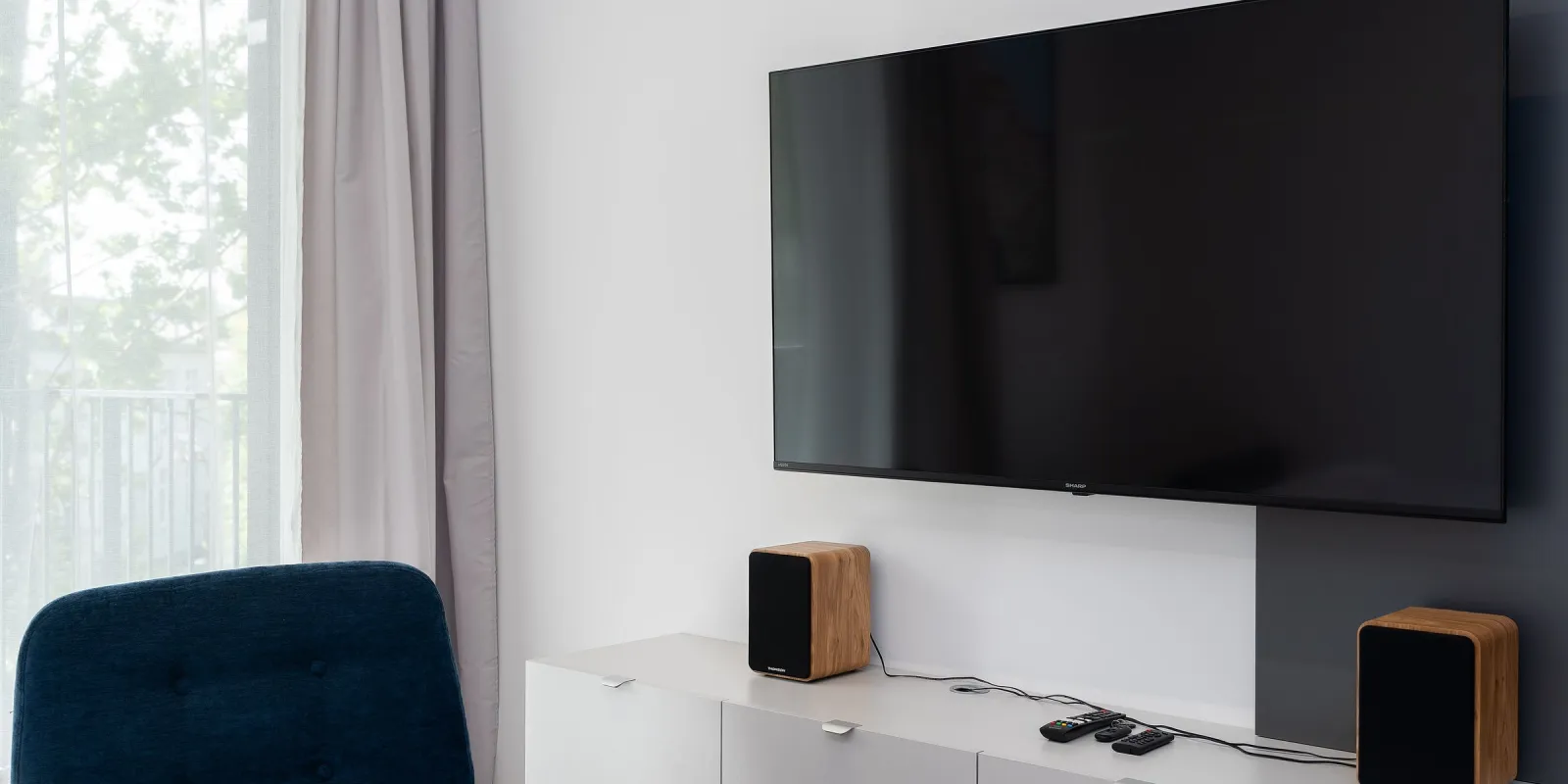
Tower speakers (also called floorstanding speakers) and bookshelf speakers can both sound excellent. The real difference is not “big is better.” It is how each design handles bass, how much room it needs, and what else you will have to buy to make it work.
In short: a tower puts more cabinet volume and more woofer area into one box that stands on the floor, so it usually digs deeper on its own. A bookshelf speaker is smaller and more flexible, but it needs a stand or solid furniture, and it often benefits from a subwoofer if you want full-range bass.
This guide walks through the trade-offs one by one, then gives you a simple decision list at the end.
How we researched this: This guide is based on manufacturer specifications, owner documentation, published third-party measurements and professional reviews. We have not hands-on tested these speakers unless a section says so. Our methodology
The quick comparison
The table below compares the two categories in general terms. Individual models vary a lot, so treat this as a starting point rather than a rule.
| Characteristic | Tower (floorstanding) | Bookshelf (standmount) |
|---|---|---|
| Cabinet volume | Large; often several times a bookshelf box | Small; limited internal air space |
| Woofers | Often two or more, or one woofer plus passive radiators | Usually one |
| Bass on its own | Deeper and louder low bass, as a rule | Tends to roll off higher; a sub fills the gap |
| Best room size | Medium to large rooms | Small to medium rooms, desks, apartments |
| Floor space | A fixed footprint at the base | Stand base takes floor space too (unless on furniture) |
| Extra purchases | Usually none beyond wire | Stands, and often a subwoofer |
| Placement flexibility | Limited; heavy and tall | High; easy to move or re-angle |
| Amplifier demand | Varies; bigger woofers can draw more power for bass | Varies; small woofers hit their limits sooner at high volume |
| Home theater role | Strong front left/right speakers | Good fronts with a sub; also common as surrounds |
Bass extension and cabinet volume
Bass is where the two designs differ most. To reproduce low notes at a useful volume, a speaker has to move a lot of air. It can do that with a larger cone area (more or bigger woofers), more cone travel, or a bigger enclosure that lets the woofer work efficiently at low frequencies. Towers have the advantage on cabinet volume and usually on cone area too.
A quick bit of arithmetic shows the scale. The Polk Monitor XT60, one of the slimmest towers in our catalogue, measures 36.4 × 7.5 × 9.09 inches on the manufacturer’s spec sheet. That is roughly 1.4 cubic feet of outside volume. The Wharfedale Diamond 12.3 measures about 38.4 × 7.1 × 13.7 inches (including its plinth), or a little over 2 cubic feet. A hypothetical bookshelf speaker measuring 12 × 7 × 9 inches would be under half a cubic foot. Those are outside dimensions, not internal air volume, but the gap is still large.
That shows up in the published bass figures. Polk lists the XT60 down to 38 Hz, using one 6.5-inch woofer plus two 6.5-inch passive bass radiators check current price on Amazon. Wharfedale lists the Diamond 12.3 at 45 Hz ±3 dB and 40 Hz at −6 dB view it on Amazon. Many bookshelf speakers quote figures in the 40s–60s Hz, though you need to check each model’s tolerance.
One caveat: a deeper spec does not automatically mean better bass in your room. Room size, speaker placement and wall distance shape low frequencies heavily. Still, if you want convincing bass from two speakers and no subwoofer, a tower is the more direct route.
Room size: where each design makes sense
Room size is the second big factor. In a small room, a tower’s extra bass can be too much of a good thing. Low frequencies build up near walls and corners, and a large tower in a 10 × 11 foot bedroom can sound boomy, especially if it has a rear port and has to sit close to the wall.
In a larger or open-plan room, the opposite problem appears. Small speakers have to work harder to fill the space, and their single small woofer reaches its limits sooner as you turn the volume up. Towers spread the work over more cone area, which generally helps at higher listening levels.
- Small rooms, desks and near-field listening: bookshelf speakers are usually the easier fit. If you still want a tower, look at slim models with passive radiators or a port plug, and see our tower speakers for small rooms guide.
- Medium rooms: either can work. This is where the budget and subwoofer question decide it.
- Large rooms and open-plan spaces: towers, or bookshelf speakers with a capable subwoofer.
Not sure what your room needs? Our room planner can help you sketch distances before you buy.
Footprint: stands take floor space too
A common assumption is that bookshelf speakers save space. That is only true if they actually sit on a bookshelf, a media console or a desk. On real bookshelves, they often sound worse, because they are boxed in and pushed close to the wall.
For good sound, most bookshelf speakers end up on floor stands that raise the tweeter to roughly ear height. Once that happens, a stand’s base plate occupies floor space that is often similar to a slim tower’s footprint. The Polk Monitor XT60, for example, sits on a 7.5 × 9.09 inch base. Your stands may need just as much room, and they still need clearance from the wall behind.
So the honest comparison is this: towers and stand-mounted bookshelf speakers take up similar floor area. Bookshelf speakers only win on space when furniture can hold them at a sensible height.
The hidden cost of stands
When you compare prices, add stands to the bookshelf column. Good stands are rigid, the right height, and stable enough not to tip. Cheap stands can wobble and rattle, which works against the speaker.
That extra cost can narrow or erase the price gap with an entry-level tower. A budget tower already includes its “stand” in the cabinet. If you are comparing a bookshelf pair and a tower pair at a similar price tier, the bookshelf route may end up costing more once stands are in the cart.
Also check whether the price is per speaker or per pair. Many towers, including the Polk Monitor XT60, are sold individually, so you need to buy two. Bookshelf speakers are more often sold in pairs. The speaker budget calculator helps you total everything.
The 2.1 alternative: bookshelf speakers plus a subwoofer
A 2.1 system means two main speakers plus one subwoofer. Pairing bookshelf speakers with a sub is the main reason the “towers always have better bass” argument is not the whole story.
A dedicated subwoofer has its own amplifier and a box built only for bass. It can often reach lower than many towers, and you can place it where the bass sounds best in the room, which is usually not where the main speakers sound best. The bookshelf speakers are freed from the deepest bass, so they can play cleaner at higher volume. A crossover around 80 Hz is a common starting point.
The downsides are real, though:
- More boxes and cables. You need a power outlet for the sub and a way to connect it (an AV receiver or an amp with a sub output makes this easy).
- Setup takes care. Blending a sub smoothly with the main speakers takes some trial and error with level, crossover and phase.
- Cost. A decent sub plus stands plus bookshelf speakers can cost more than a pair of entry-level towers.
If you go this route, compare cabinet sizes and sensitivity ratings across bookshelf speakers on Amazon before you pick a sub to match. We also explain when a sub makes sense with towers in do tower speakers need a subwoofer?
Home theater: fronts, surrounds and the sub question
In a home theater, the front left and right speakers carry a large share of the soundtrack, including music and effects that pan across the screen. Towers are a natural choice here because they handle wide dynamics and fill a room without strain.
That said, almost every surround system benefits from a subwoofer for the low-frequency effects (LFE) channel. Once a sub is in the system, an AV receiver usually redirects the deepest bass to it, so the towers’ bass advantage matters less. Bookshelf speakers as fronts can then work very well, especially in medium rooms.
A practical approach many people take:
- Towers as front left/right, a matching center channel, bookshelf speakers as surrounds, and a subwoofer.
- Or bookshelf speakers all round plus a subwoofer, when space or budget is tight.
Our best tower speakers for home theater guide covers models that suit this role.
Upgrade path
Think about where your system will be in two or three years.
Starting with towers gives you a complete stereo system on day one. Later you can add a subwoofer for movies or very deep bass, and the towers become the front pair of a surround system. The catch: if you later want much better speakers, towers are a bigger, heavier purchase to replace and to resell.
Starting with bookshelf speakers is often cheaper up front. You can add a sub when budget allows, and if you later move to towers, the bookshelf speakers can become surrounds or move to a second room. That flexibility is a genuine advantage.
Either way, the amplifier matters. Low-sensitivity speakers need more power for the same volume (each 3 dB lower sensitivity means roughly double the power). Check our amplifier guide before you commit.
Example towers from our catalogue
If the comparison has pointed you toward towers, these two show the range at the slimmer end of the market. Both are passive and need an amplifier or receiver.
The Polk Monitor XT60 is a slim, light 2-way tower with passive radiators instead of a port, which on paper makes near-wall placement less critical. Note that Polk rates its 86 dB sensitivity at 1 watt rather than the more common 2.83 volts, so it is not directly comparable to other brands’ figures.
A slim, light entry-level tower that uses passive bass radiators instead of a port — an easy, affordable first step up from bookshelf speakers.
The Wharfedale Diamond 12.3 is a narrow 2.5-way design with an 8-ohm nominal rating and a 5-ohm minimum per Wharfedale, which is an easy load for modest integrated amplifiers.
A slim 7.1 in. wide 2.5-way tower with an easy 8-ohm-compatible load — a natural fit for smaller rooms and modest stereo amplifiers.
For a wider shortlist, see the best tower speakers pillar guide and our budget picks.
Which should you choose?
Use this list to decide. If most of your answers land in one column, that is your answer.
- Choose towers if you want full-range stereo from just two boxes, without a subwoofer.
- Choose towers if your room is medium to large, or open-plan, and you listen at moderate to high volume.
- Choose towers if you are building a home theater and want strong front left/right speakers.
- Choose towers if you would need floor stands for bookshelf speakers anyway, so the floor space is the same.
- Choose bookshelf speakers if your room is small, or you listen at a desk or close up.
- Choose bookshelf speakers if you already own or plan to buy a subwoofer.
- Choose bookshelf speakers if furniture can hold them at roughly ear height, so you skip stands.
- Choose bookshelf speakers if you move often, or want speakers you can reuse as surrounds later.
Still undecided? Try the speaker match finder.
Frequently asked questions
Do tower speakers sound better than bookshelf speakers?
Not automatically. Towers usually reach deeper bass and play louder with less strain because they have more cabinet volume and woofer area. But a well-designed bookshelf speaker can match or beat a cheaper tower in the midrange and treble, and with a subwoofer it can match the bass too. Room size, placement and amplifier choice often matter as much as the speaker type.
Are tower speakers too big for a small room?
They can be. Large towers, especially rear-ported ones placed close to a wall, can make bass sound boomy in a small room. Slim towers with passive radiators or a supplied port plug are easier to manage. In very small rooms or at a desk, bookshelf speakers are usually the better fit.
Do bookshelf speakers need stands?
Not always, but they usually sound best on stands that put the tweeter near ear height and keep them away from walls. On a bookshelf, the surrounding cavity and wall can exaggerate bass and blur detail. A sturdy media console or desk can work if the height is right. Remember that stands add cost and take up floor space.
Is a 2.1 system better than tower speakers?
A bookshelf pair plus a good subwoofer can deliver deeper bass than many towers, and lets you place the sub where bass sounds best. The trade-off is more cost, more cables and more setup. Towers give you a simpler, two-box system with fuller bass than bookshelf speakers alone. Many people later add a sub to towers too.
Do tower speakers need a more powerful amplifier?
Not necessarily. Power needs depend mostly on sensitivity and impedance, not size. Some towers are very efficient and easy to drive, while some small bookshelf speakers are not. Compare sensitivity figures measured the same way, check the minimum impedance, and leave some headroom. Our amplifier compatibility checker can help.
Next steps
If towers suit your room, start with our how to choose tower speakers guide, then compare models in the best tower speakers roundup. Planning around an existing amp? Run your numbers through the amplifier compatibility checker first.
Leave a Reply