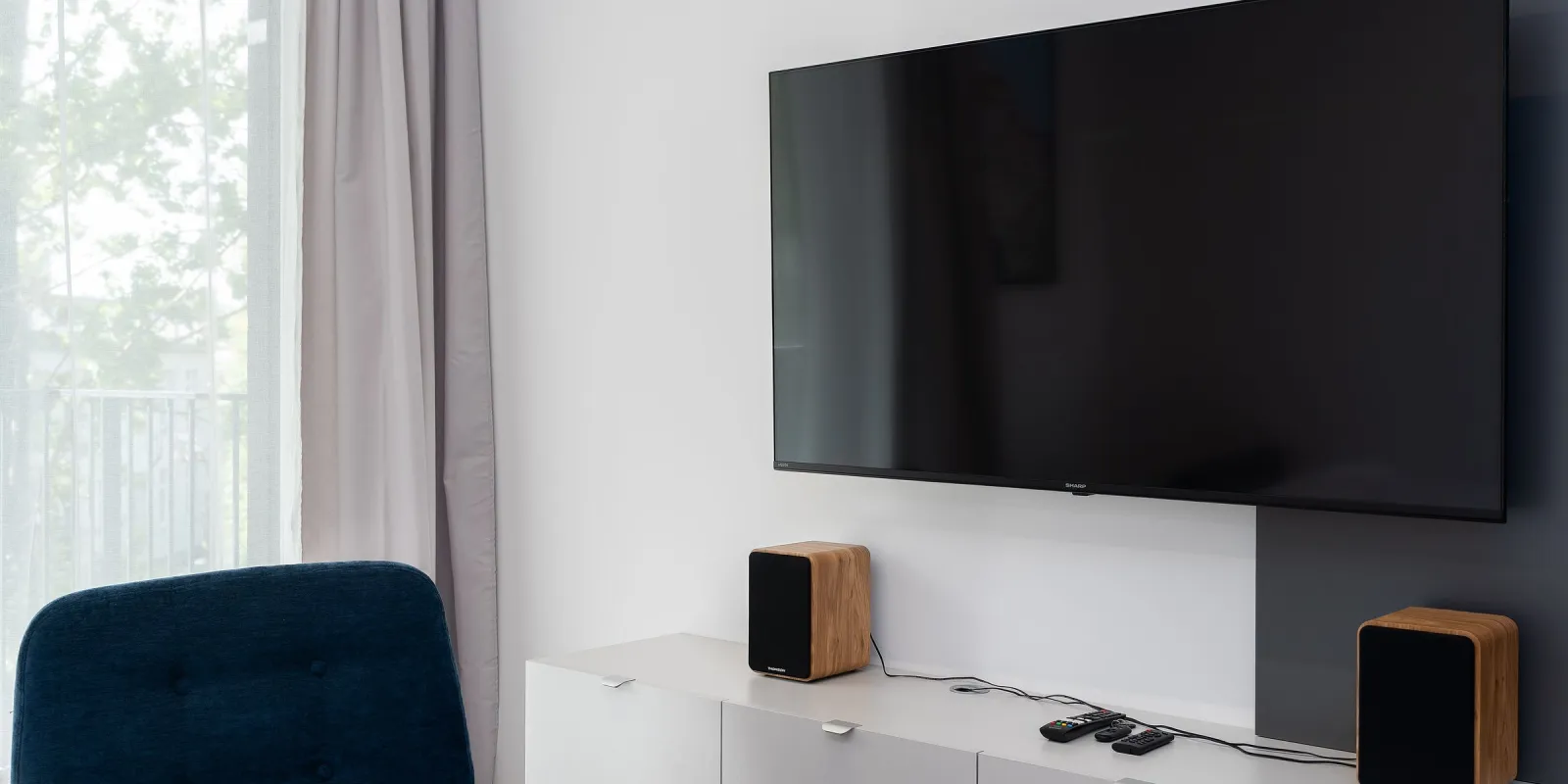
If you want better sound than your TV’s built-in speakers, the two most common choices are a soundbar and a pair of bookshelf speakers. Soundbars win on simplicity; bookshelf speakers usually win on sound quality and flexibility. This updated guide (with model-specific claims from the earlier version removed) helps you decide.
Bookshelf speakers overview
Compact stereo speakers placed on stands, shelves or furniture. Powered models have amplifiers built in (often with Bluetooth and optical inputs); passive models need an amplifier or AV receiver.
Soundbars overview
A single wide speaker under the TV, usually connected by HDMI eARC/ARC or optical. Many include a wireless subwoofer, virtual surround and dialogue enhancement; premium models support Dolby Atmos.
Head-to-head
| Factor | Bookshelf speakers | Soundbar |
|---|---|---|
| Music quality | Usually better, true stereo | Good on better models; narrower stereo |
| TV dialogue | Good; better with a center in surround setups | Excellent, with dialogue modes |
| Setup | Two speakers + amp (unless powered) | One box, often one HDMI cable |
| Upgradeability | High (add sub, upgrade amp, go surround) | Limited to brand add-ons |
| Space | Two positions plus stands | Under the TV only |
Pros and cons
Bookshelf speakers
- + Better stereo imaging and music quality
- + Flexible, upgradeable
- – More setup and space
Soundbars
- + Simple, tidy, TV-friendly
- + Dialogue enhancement, virtual surround
- – Narrower stereo; harder to upgrade
Recommended scenarios
- Music lovers / desks / small rooms: bookshelf speakers — see bookshelf speakers under $200.
- TV in a minimalist space: soundbar.
- Bigger rooms and home theater: consider tower speakers with an AV receiver — see best tower speakers for home theater.
Explore soundbars on Amazon · Explore powered bookshelf speakers
The hybrid option: bookshelf speakers plus a subwoofer
A pair of bookshelf speakers with a compact subwoofer (a 2.1 system) combines true stereo width with deep bass. Powered bookshelf speakers with a subwoofer output make this especially simple, while an AV receiver lets you grow into 5.1 surround later. For many living rooms this offers better music and movie sound than a similarly priced soundbar.
What to look for in a soundbar
- HDMI eARC/ARC for simple TV control and lossless formats on supported models.
- A dedicated center channel for clearer dialogue.
- Wireless subwoofer for real bass.
- Room calibration on higher-end models.
- Upgrade options: rear speakers or Atmos up-firing drivers.
What to look for in bookshelf speakers
- Powered or passive — powered for simplicity, passive for flexibility.
- Inputs on powered models: optical, HDMI ARC or Bluetooth.
- Size and port position relative to where they’ll sit.
- Stands to place tweeters at ear height.
Frequently asked questions
Are bookshelf speakers better than a soundbar for TV?
For overall sound, often yes; for simplicity and dialogue clarity in one box, a soundbar is easier.
Can bookshelf speakers connect to a TV?
Yes — powered models via optical/HDMI/aux, passive models through an amplifier or AV receiver.
Do soundbars work for music?
Better soundbars handle music well, but true stereo speakers usually sound wider and more natural.
Related guides: Floor-standing vs bookshelf · Are tower speakers worth it?


Leave a Reply