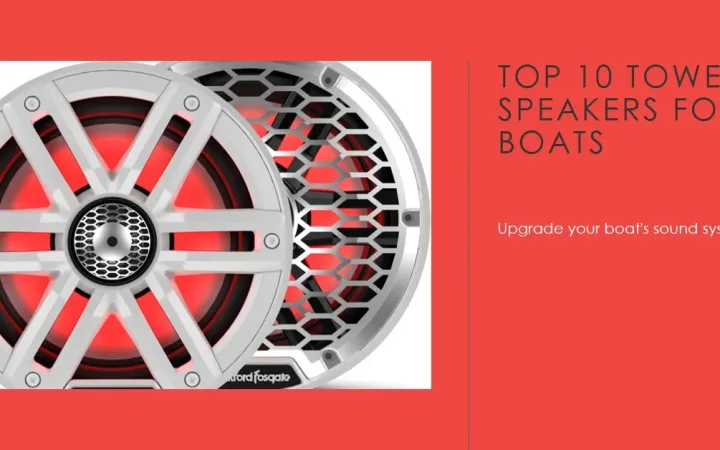
Marine tower speakers lift sound above the deck so it carries across the water — essential for wakeboarding, wakesurfing and open-air cruising. This guide explains what to look for and lists the brands and models from our original roundup, with clearer notes on what each spec means.
We’ve removed peak-wattage claims and lighting hype from the earlier version and added care and installation guidance.
Benefits over in-cabin speakers
- Sound projects behind the boat to riders.
- Elevated placement avoids passengers blocking the sound.
- Higher output designs overcome wind and engine noise.
Specs that matter
- RMS power handling: match it to your amplifier; ignore peak figures.
- Sensitivity: higher sensitivity means more volume per watt — valuable outdoors.
- Driver size and horn tweeters: larger cones and horns improve throw.
- Water resistance: check IP ratings and marine certifications.
- Cone material: polypropylene is popular in marine speakers because it resists moisture well.
Models from our original list
Verify current availability and specifications before buying; some are coaxial speakers rather than tower pods.
- Rockville Rockpods (tower pods) — explore
- Pyle Hydra marine speakers — explore
- BOSS Audio marine speakers — explore
- Kenwood marine coaxials (including Excelon) — explore
- Polk Audio UltraMarine — explore
- Kicker Marine LED speakers — explore
- JBL Stadium Marine — explore
- NOAM and Skar Audio marine speakers — compare on each brand’s site
Installation
- Confirm clamp sizes for your tower tubing.
- Use tinned marine wire and sealed connections.
- Install a properly fused marine amplifier.
- Aim pods slightly downward and aft for riders.
Care
- Rinse with fresh water after saltwater use.
- Use covers when the boat is stored.
- Inspect clamps and connections each season.
Understanding marine durability ratings
Marine speakers are often described with IP ratings and marine test standards. An IP rating has two digits: the first for dust, the second for water. IPX5 means protection against water jets; IPX6 against powerful jets; IPX7 against temporary immersion. Some manufacturers also reference salt-fog and UV testing (for example ASTM standards), which indicate resistance to corrosion and sun damage — important for speakers mounted high on a tower in direct sunlight.
Amplifier matching
- Choose a marine amplifier with RMS output close to the speakers’ RMS rating.
- Check impedance: some tower speakers are 4-ohm and some 2-ohm capable amps can drive multiple pairs — follow the manufacturers’ guidance.
- Set gains carefully to avoid clipping, which damages tweeters.
- Install correctly sized power wire and fuses near the battery.
Tower pods vs coaxial marine speakers
Coaxial marine speakers flush-mount into panels around the boat for passengers. Tower pods are enclosed and aimed outward or aft for riders and open-water listening. Most wake boats use both: coaxials in the cockpit and two or more tower pods up high.
Frequently asked questions
What are marine tower speakers?
Weather-resistant speaker pods that clamp to a boat’s wakeboard tower or frame to project sound across the deck and behind the boat.
Why polypropylene cones?
Polypropylene resists moisture and doesn’t degrade like untreated paper, which suits marine environments.
How many tower speakers do I need?
Two aft-facing pods are typical; larger boats or wakesurf setups may add more plus in-boat speakers.
Related guides: Tower speakers for boats · Kicker vs Wet Sounds · JL Audio vs Wet Sounds
Leave a Reply