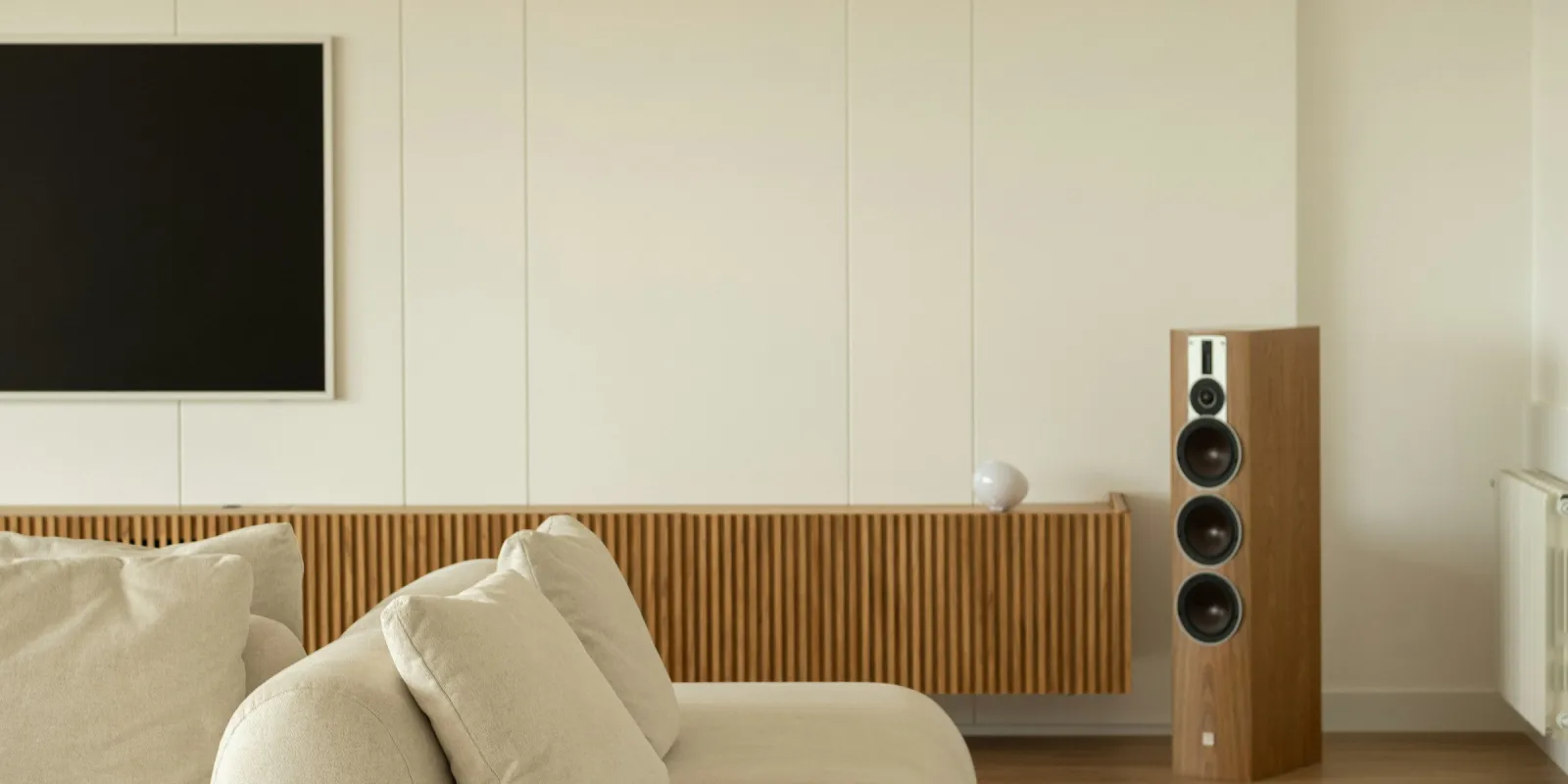
Tower speakers take up floor space and usually need a separate amplifier, so it’s fair to ask whether they’re worth it. For many people the answer is yes — they deliver a scale and bass depth that small speakers and soundbars can’t match. But they aren’t the right choice for every room or budget.
We’ve updated this article to remove a list of unnamed “best” models from the original and to make the advice more specific.
Advantages of tower speakers
1. Fuller, deeper sound
Tall cabinets hold more air and more drivers. That typically means deeper bass and more effortless volume than bookshelf speakers of similar quality.
2. Full range without a subwoofer
Many towers reach into the 30s Hz, enough for most music without a sub. Movies still benefit from one.
3. Versatility
Towers work for stereo music and as front speakers in home theater, and they need no stands.
The trade-offs
- Space: they need floor space and some room from walls.
- Amplification: passive towers need a receiver or amplifier.
- Room fit: large towers can make bass boomy in small rooms.
- Cost: two towers plus an amplifier usually cost more than a soundbar.
What’s changed in recent years
- Streaming amplifiers and receivers add Wi-Fi, Bluetooth and multi-room features to passive towers.
- Room correction (Audyssey, YPAO, Dirac and others) helps towers integrate with real rooms.
- Atmos module support on some towers (e.g. JBL Stage 280F, Klipsch RP-8000F II) adds height effects.
Compared with other options
| Option | Best for | Main limitation |
|---|---|---|
| Tower speakers | Full-range sound, medium–large rooms | Space and amplifier needed |
| Bookshelf speakers | Small rooms, tighter budgets | Less bass; need stands |
| Soundbars | Simplicity under the TV | Limited stereo width and bass without a sub |
| In-wall speakers | Invisible installs | Installation work; placement fixed |
More detail: tower vs bookshelf · bookshelf speakers vs soundbars.
Good towers to consider
Polk Audio Monitor XT70
The bigger Monitor XT adds a second woofer and two 8 in. front-mounted passive radiators for more bass, while staying easy to drive.
- 35 Hz rated bass extension (tolerance not stated)
- Front passive radiators tolerate near-wall placement
- 89 dB sensitivity suits entry-level receivers
- Design2-way passive
- Drivers1 in. Terylene dome tweeter, 2x 6.5 in. bi-laminate paper woofers, 2x 8 in. passive bass radiators (front array)
- Sensitivity89 dB (1W)
- Impedance4–8 Ω amp compatible
ELAC Debut 3.0 DF63
The larger Debut 3.0 tower: a 3-way with 6.5 in. drivers and 31 Hz (−6 dB) extension in a slim 7.7 in. cabinet.
- True 3-way with dedicated midrange
- 31 Hz rated extension (−6 dB)
- Slim cabinet with outriggers and spikes
- Design3-way passive
- Drivers1 in. aluminum dome tweeter, 1x 6.5 in. aramid-fiber midrange, 2x 6.5 in. aramid-fiber woofers
- Sensitivity87.5 dB (2.83V)
- Impedance4–6 Ω (sources differ; min 3.6 Ω)
Polk Audio Signature Elite ES60
Three 6.5 in. woofers, 90 dB sensitivity and 32 Hz rated extension make this a versatile, easy-to-drive tower for music and movies in medium to large rooms.
- 90 dB (2.83V) sensitivity plays loud on modest power
- Three woofers for bass weight and output
- Widely available in the US
- DesignPassive, 4 drivers (3 woofers)
- Drivers1 in. Terylene dome tweeter, 3x 6.5 in. mica-reinforced polypropylene woofers
- Sensitivity90 dB (2.83V)
- Impedance4–8 Ω amp compatible
Setup and care tips
- Placement: start 2–3 feet from the back wall, in an equilateral triangle with your seat, with slight toe-in. See the placement guide.
- Cleaning: dust with a dry microfiber cloth; don’t use solvents on cones or veneer.
- Moisture: keep away from damp areas and direct sunlight.
- Avoid overdriving: distortion from a clipping amplifier is a common cause of tweeter damage.
- Connections: check binding posts occasionally for tightness.
Who should skip tower speakers
- Renters in very small studios where floor space is precious.
- Anyone who wants a single box and remote — a soundbar fits better.
- Shoppers with a very tight total budget that must also cover an amplifier — a good bookshelf pair may sound better.
Cost of a complete tower system
Budget for the speakers (often sold individually), an amplifier or AV receiver, speaker wire and, optionally, a subwoofer. Our budget calculator suggests a starting split, and our Match Finder recommends a speaker type for your room.
Frequently asked questions
Are tower speakers better than a soundbar?
For sound quality, generally yes — a pair of towers gives wider stereo and fuller bass. A soundbar wins on simplicity and space.
Do tower speakers need an amplifier?
Passive towers (most models) do. Powered Bluetooth towers have amps built in but usually sound less refined.
Are tower speakers worth it in an apartment?
Slim towers can work well in apartments; keep volume and bass considerate of neighbors, and consider isolation pads.
Related guides: Are floor-standing speakers better? · What are tower speakers? · Best tower speakers
Leave a Reply