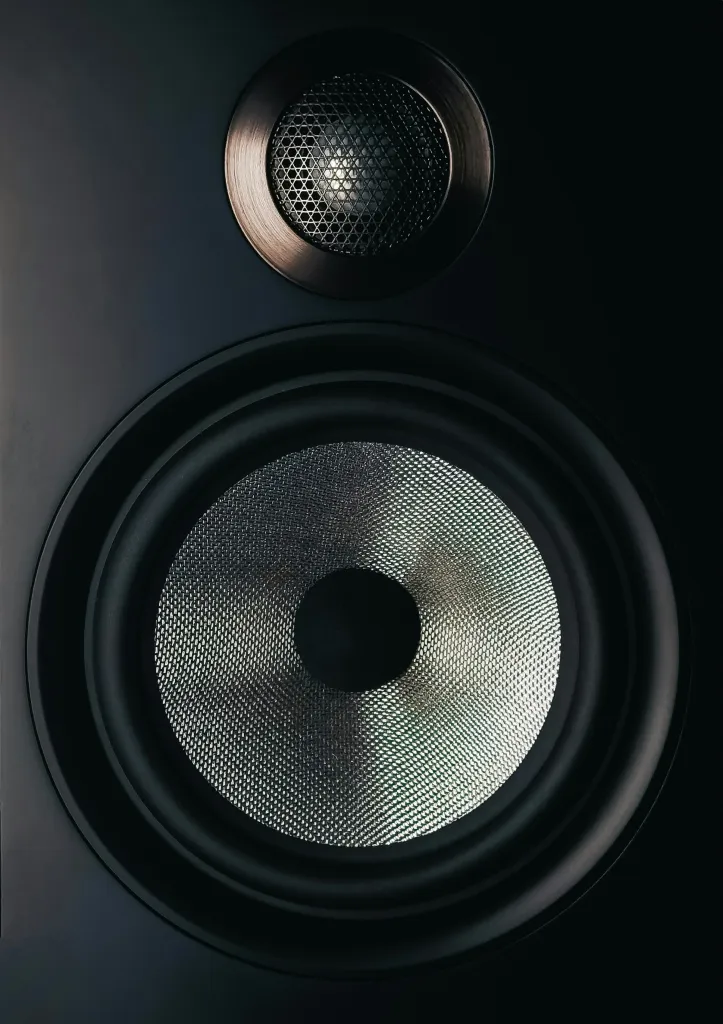
The ELAC Uni-Fi UF5 was the flagship tower of ELAC’s original Uni-Fi series, designed by Andrew Jones. Its party piece was a concentric driver — a tweeter mounted at the center of the midrange — in a genuinely affordable 3-way tower.
The UF5 has been succeeded by the Uni-Fi 2.0 UF52 and, more recently, ELAC’s Uni-Fi Reference line (UFR52), which reviewers position as a step up rather than a like-for-like replacement. This updated review explains the UF5’s design and what to look for if you buy one used. (We removed a star score from the earlier version.)
How we researched this: This guide is based on manufacturer specifications, owner documentation, published third-party measurements and professional reviews. We have not hands-on tested these speakers unless a section says so. Our methodology
Design and features
- Concentric tweeter/midrange: a 1-inch soft-dome tweeter at the center of a 4-inch aluminum midrange cone, so treble and midrange radiate from the same point — good for imaging and off-axis consistency.
- True 3-way: the midrange handles vocals, while three 5.25-inch aluminum woofers handle bass.
- Bass-reflex cabinet with a furniture-grade finish and quality binding posts.
- 4-ohm nominal impedance: pair it with an amplifier or receiver rated for 4-ohm speakers.
Pros and cons
Pros
- Concentric driver gives coherent imaging.
- True 3-way design at an affordable price when new.
- Attractive, well-finished cabinet.
Cons
- Discontinued — used only.
- Demanding 4-ohm load.
- Small woofers limit very deep bass in large rooms.
Successors and alternatives
ELAC’s current concentric towers are the Uni-Fi Reference models; check availability: see ELAC Uni-Fi Reference options on Amazon. From our catalogue, ELAC’s own Debut 3.0 towers and the KEF Q7 Meta (another coincident-driver design) are strong alternatives:
ELAC Debut 3.0 DF63
The larger Debut 3.0 tower: a 3-way with 6.5 in. drivers and 31 Hz (−6 dB) extension in a slim 7.7 in. cabinet.
- True 3-way with dedicated midrange
- 31 Hz rated extension (−6 dB)
- Slim cabinet with outriggers and spikes
- Design3-way passive
- Drivers1 in. aluminum dome tweeter, 1x 6.5 in. aramid-fiber midrange, 2x 6.5 in. aramid-fiber woofers
- Sensitivity87.5 dB (2.83V)
- Impedance4–6 Ω (sources differ; min 3.6 Ω)
KEF Q7 Meta
KEF’s Uni-Q point-source driver with Metamaterial Absorption Technology aims for precise imaging; a port bung helps in smaller rooms.
- Uni-Q coincident driver for even dispersion
- Response quoted ±3 dB (46 Hz–20 kHz)
- Port bung included for near-wall use
- Design3-way passive
- DriversUni-Q array (0.75 in. vented aluminum dome tweeter with MAT + 4 in. aluminum midrange cone), 2x 6.5 in. hybrid aluminum bass cones
- Sensitivity87 dB (2.83V)
- Impedance4 Ω nominal (3.2 Ω min)
ELAC Debut 3.0 DF53
A very slim (6.8 in. wide) 3-way tower from ELAC’s latest Debut range — a tidy fit for smaller rooms.
- True 3-way design in a 6.8 in. wide cabinet
- Outrigger feet and spikes included
- Magnetic grilles
- Design3-way passive
- Drivers1 in. aluminum dome tweeter, 1x 5.25 in. aramid-fiber midrange, 2x 5.25 in. aramid-fiber woofers
- Sensitivity87.5 dB (2.83V)
- Impedance4–6 Ω (sources differ; min 4.2 Ω)
Frequently asked questions
Is the ELAC Uni-Fi UF5 discontinued?
Yes. It was followed by the Uni-Fi 2.0 UF52 and later the Uni-Fi Reference range.
What is a concentric driver?
A tweeter mounted in the center of a midrange (or mid/bass) cone so both share one acoustic center. KEF’s Uni-Q and ELAC’s Uni-Fi drivers use this approach for consistent imaging.
Can an AV receiver drive the UF5?
Many can, but check that yours is rated for 4-ohm speakers and has adequate power. Low impedance makes amplifiers work harder.
Is the UF5 better than the ELAC Debut towers?
The UF5’s concentric 3-way design was a step up from the Debut 2.0 range of its time. Today, the Debut 3.0 DF63 is a current 3-way alternative with a warranty.
Verdict
The Uni-Fi UF5 remains a sophisticated speaker for its original price. Buy used if it’s in good condition and you have a 4-ohm-capable amplifier; otherwise look at ELAC’s current lines.
Related guides: ELAC Debut 3.0 DF63 review · Best 3-way floor-standing speakers · 2-way vs 3-way
Leave a Reply