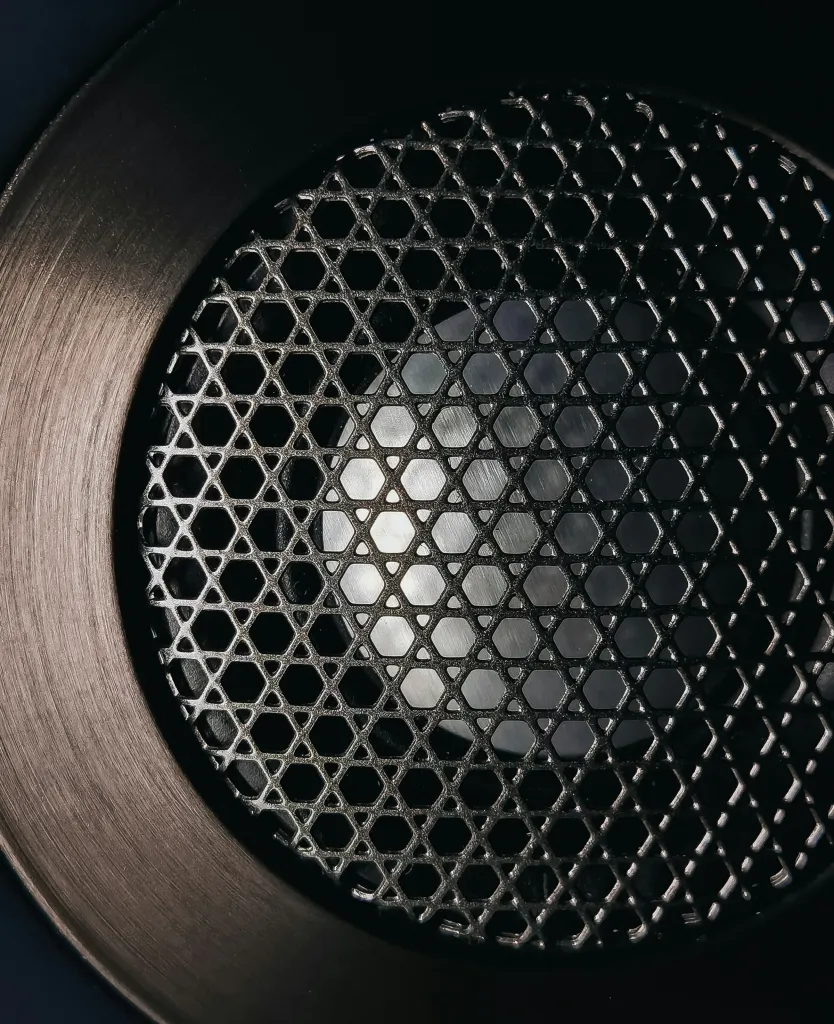
The KEF Q500 was one of the most talked-about mid-priced towers of its generation. Its headline feature was KEF’s Uni-Q driver — a tweeter mounted in the center of a midrange/bass cone so that both radiate from the same point. That design, more common in far pricier speakers, gave the Q500 even dispersion and stable stereo imaging.
KEF has since replaced the Q500 with later Q-series generations, most recently the Q Meta range. This updated review explains the Q500’s design, what to look for if you buy one used, and how it relates to today’s KEF towers. (An earlier version of this page described the Q500 as having three woofers and quoted customer star ratings; we’ve corrected and removed those details.)
How we researched this: This guide is based on manufacturer specifications, owner documentation, published third-party measurements and professional reviews. We have not hands-on tested these speakers unless a section says so. Our methodology
Design and technology
The Uni-Q driver
Most speakers place the tweeter above the woofer, so the two sound sources sit a few inches apart. As you move around the room, the timing between them changes, which affects tonal balance and imaging. KEF’s Uni-Q puts the tweeter in the acoustic center of the midrange cone, so treble and midrange come from one point. In practice this tends to give a wide sweet spot and consistent sound across the room.
Bass section
Below the Uni-Q, the Q500 used additional 5.25-inch bass drivers, including auxiliary bass radiators (ABRs) — unpowered cones that extend bass output without a conventional port. The result is a relatively slim tower that still produces convincing bass for its size.
Build and finish
The Q500 came in several finishes and sat on a plinth with adjustable spikes for stability on carpet. Spikes decouple the cabinet from soft floors; on hardwood, use spike shoes or floor protectors.
Pros and cons
Pros
- Uni-Q driver gives even dispersion and stable imaging.
- Slim cabinet for a full-range tower.
- Auxiliary bass radiators avoid port noise.
- Multiple finishes to suit different rooms.
Cons
- Discontinued — used units carry no warranty.
- Small 5.25-inch drivers limit deep bass and maximum volume in large rooms.
- Benefits from a capable amplifier rather than the most basic receivers.
Buying a Q500 used
- Check the aluminum cones and the tweeter at the center of the Uni-Q for dents.
- Listen for buzzes at moderate volume.
- Make sure plinths and spikes are included.
- Compare the price with a new KEF Q Meta model — the newer generation adds KEF’s Metamaterial Absorption Technology (MAT) behind the tweeter.
Successors and alternatives
Earlier versions of this article compared the Q500 with the Fluance XL5F and Polk Monitor 70 — both superseded. Today’s equivalents:
KEF Q7 Meta
KEF’s Uni-Q point-source driver with Metamaterial Absorption Technology aims for precise imaging; a port bung helps in smaller rooms.
- Uni-Q coincident driver for even dispersion
- Response quoted ±3 dB (46 Hz–20 kHz)
- Port bung included for near-wall use
- Design3-way passive
- DriversUni-Q array (0.75 in. vented aluminum dome tweeter with MAT + 4 in. aluminum midrange cone), 2x 6.5 in. hybrid aluminum bass cones
- Sensitivity87 dB (2.83V)
- Impedance4 Ω nominal (3.2 Ω min)
KEF Q11 Meta
The flagship Q Meta adds a third bass driver for more output and authority in larger rooms.
- Three 6.5 in. bass drivers plus Uni-Q array
- 89 dB sensitivity
- Response quoted ±3 dB (44 Hz–20 kHz)
- Design3-way passive
- DriversUni-Q array (0.75 in. vented aluminum dome tweeter with MAT + 4 in. aluminum midrange cone), 3x 6.5 in. hybrid aluminum bass cones
- Sensitivity89 dB (2.83V)
- Impedance4 Ω nominal (3.2 Ω min)
Wharfedale Diamond 12.3
A slim 7.1 in. wide 2.5-way tower with an easy 8-ohm-compatible load — a natural fit for smaller rooms and modest stereo amplifiers.
- Slim cabinet suits smaller rooms
- Easy load: 8 Ω compatible, 5 Ω minimum
- Response quoted ±3 dB (45 Hz–20 kHz)
- Design2.5-way passive
- Drivers1 in. (25 mm) textile dome tweeter, 5 in. (130 mm) mid/bass, 5 in. (130 mm) bass (Klarity PP cones)
- Sensitivity89 dB (2.83V)
- Impedance8 Ω nominal (5.0 Ω min)
| Product | Design | Drivers | Frequency response | Sensitivity | Impedance | Dimensions | Sold as | Best for | Amazon |
|---|---|---|---|---|---|---|---|---|---|
| KEF Q7 Meta | 3-way passive | Uni-Q array (0.75 in. vented aluminum dome tweeter with MAT + 4 in. aluminum midrange cone), 2x 6.5 in. hybrid aluminum bass cones | 46 Hz–20 kHz +/- 3 dB (39 Hz–20 kHz at -6 dB) | 87 dB (2.83V) | 4 Ω nominal (3.2 Ω min) | 39.4 × 12.5 × 12.4 in. (H×W×D) | Single speaker | Best for Audiophiles | View |
| KEF Q11 Meta | 3-way passive | Uni-Q array (0.75 in. vented aluminum dome tweeter with MAT + 4 in. aluminum midrange cone), 3x 6.5 in. hybrid aluminum bass cones | 44 Hz–20 kHz +/- 3 dB (37 Hz–20 kHz at -6 dB) | 89 dB (2.83V) | 4 Ω nominal (3.2 Ω min) | 41.8 × 8.3 × 15 in. (H×W×D) | Single speaker | Large-room Uni-Q | View |
| Wharfedale Diamond 12.3 | 2.5-way passive | 1 in. (25 mm) textile dome tweeter, 5 in. (130 mm) mid/bass, 5 in. (130 mm) bass (Klarity PP cones) | 45 Hz–20 kHz +/- 3 dB (40 Hz at -6 dB) | 89 dB (2.83V) | 8 Ω nominal (5.0 Ω min) | 38.4 × 7.1 × 13.7 in. (H×W×D) | Check listing | Best for Small Rooms | View |
| ELAC Debut 3.0 DF63 | 3-way passive | 1 in. aluminum dome tweeter, 1x 6.5 in. aramid-fiber midrange, 2x 6.5 in. aramid-fiber woofers | 31 Hz–38 kHz (-6 dB) | 87.5 dB (2.83V) | 4–6 Ω (sources differ; min 3.6 Ω) | 43.1 × 7.7 × 10.6 in. (H×W×D) | Check listing | Best Under $1,000 | View |
Specifications are manufacturer-published figures. Measurement methods differ between brands, so treat small differences with caution.
Frequently asked questions
What replaced the KEF Q500?
KEF followed the Q500 with later Q-series generations. The current Q Meta range’s floorstanders are the Q7 Meta and the larger Q11 Meta, both using an updated Uni-Q driver with Metamaterial Absorption Technology.
What is a Uni-Q driver?
It’s KEF’s coincident driver: the tweeter sits at the center of the midrange cone so both radiate from a single point. That keeps tonal balance and imaging consistent across a wider listening area.
Is the KEF Q500 good for home theater?
Yes, as front speakers in small to medium rooms, especially with a subwoofer to handle the deepest bass. Its even dispersion helps viewers sitting off-center.
Does the Q500 need a powerful amplifier?
It doesn’t need huge power, but a decent amplifier or receiver with some headroom will serve it better than the cheapest options. Check compatibility with our amplifier checker.
Verdict
The KEF Q500 brought high-end imaging ideas to an affordable tower, and a well-kept pair can still be a smart used buy for small and medium rooms. For a new purchase, the KEF Q7 Meta is its natural successor.
Related guides: KEF Q750 vs SVS Prime Tower · 2-way vs 3-way speakers · Best tower speakers for music · Best tower speakers for audiophiles
Leave a Reply