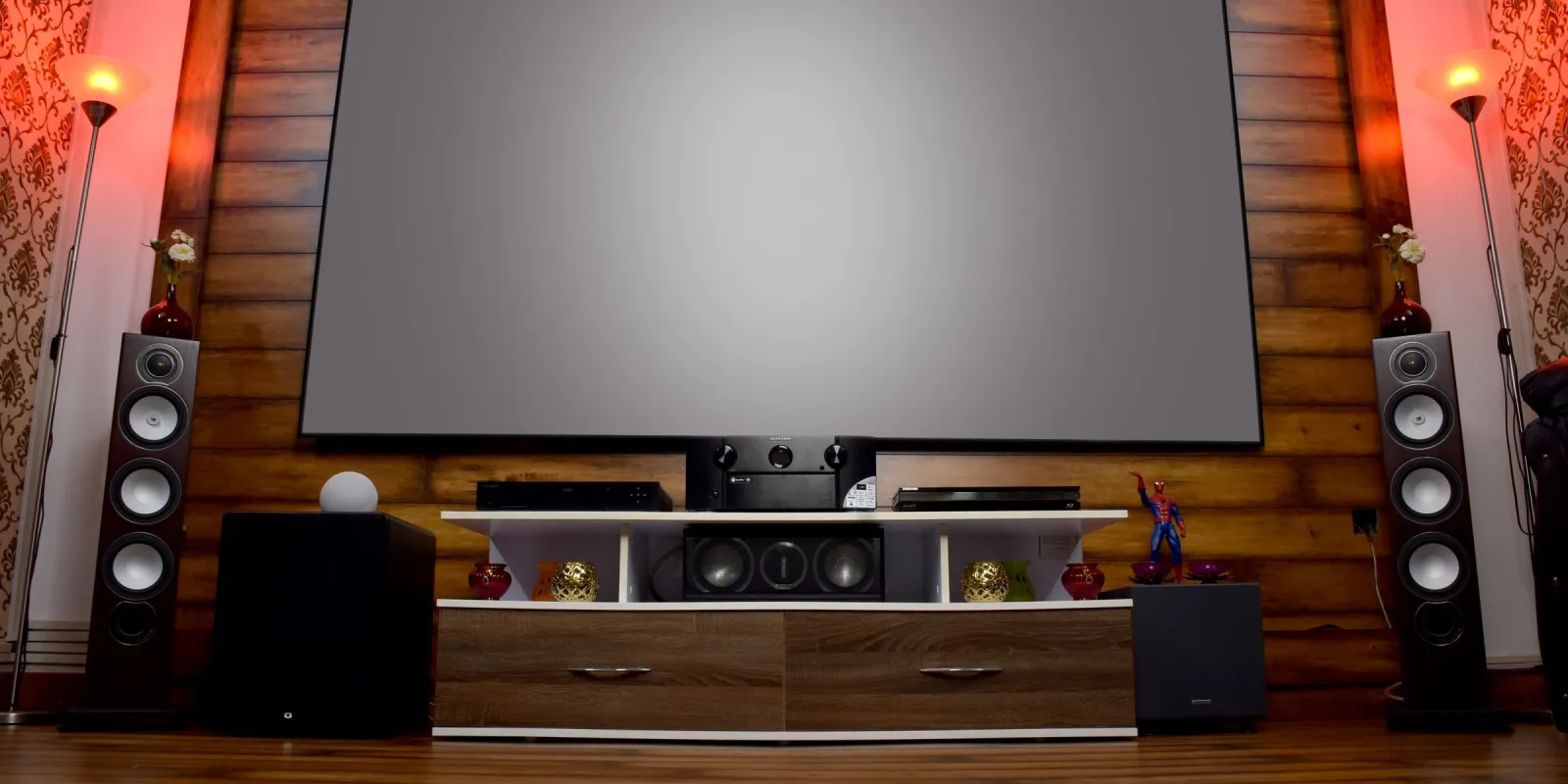
When you build a home theater, one of the first decisions is whether to use full-size floor-standing speakers for the front left and right channels, or small satellite speakers paired with a subwoofer. Both can work brilliantly — they just suit different rooms, budgets and priorities.
This is an updated version of one of our earliest guides. We’ve kept its core advice — think about compatibility and the whole system, not just size — and added clearer explanations of how each approach handles bass.
What are satellite speakers?
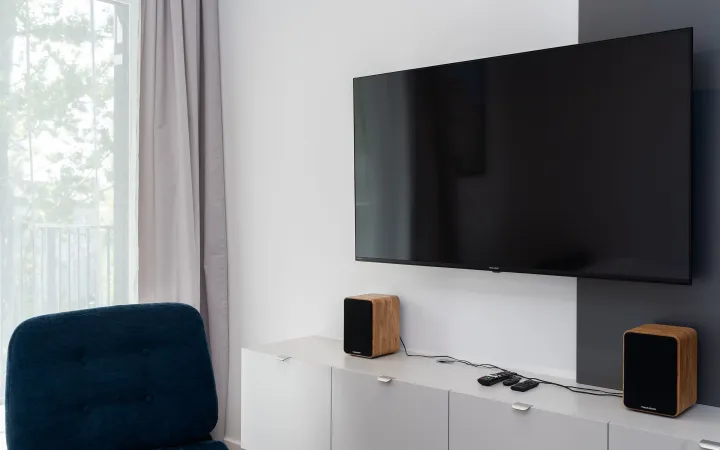
Satellites are compact speakers — often smaller than bookshelf speakers — designed to handle midrange and treble while a subwoofer reproduces bass. Many are sold in matched “5.1” packages with a center channel and sub. Because they’re small, they’re easy to wall-mount and hide, but they rely completely on the subwoofer below roughly 100–150 Hz.
How the two approaches compare
| Floor-standing | Satellites + sub | |
|---|---|---|
| Bass | Handled partly by the towers; a sub adds depth | Entirely by the subwoofer |
| Space | Floor space for two tall cabinets | Small; easy to wall-mount |
| Dynamics at volume | Higher | Limited by small drivers |
| Setup sensitivity | Placement affects bass | Sub placement and crossover are critical |
| Best room | Medium–large | Small–medium |
Five things to check before choosing
1. Compatibility across the system
Whatever you choose, make sure the front speakers, center channel and surrounds have a similar tonal character. The easiest way is to stay within one brand’s matching series. A mismatched center channel is the most common reason dialogue sounds “different” from the rest of the soundtrack.
2. The subwoofer
With satellites, the sub does a lot of work — choose a capable one and place it carefully. With towers, a sub is optional but still adds depth for movies. See do tower speakers need a subwoofer?
3. Crossover settings
Your AV receiver’s bass management sends low frequencies to the sub. Set small satellites to “Small” with a crossover around 100–120 Hz (check the manufacturer’s recommendation); towers often work well set to “Small” at 80 Hz with a sub, or “Large” without one.
4. Room size and layout
In small rooms, satellites avoid boomy bass and clutter. In larger rooms, towers fill the space more convincingly.
5. Looks and practicality
Satellites win for discretion; towers win for impact. Think about where cables run and whether you can place speakers at ear height.
Our take
If you have the floor space, a pair of towers for the front channels plus a subwoofer is the most versatile home theater foundation. If space or appearance comes first, a good satellite-and-sub system can still sound impressive when set up carefully.
JBL Stage 280F
Dual 8 in. woofers, a waveguide tweeter and 91 dB sensitivity give the Stage 280F big-room output for movies at a mid-range price.
- Dual 8 in. woofers; 33 Hz (±6 dB)
- 91 dB sensitivity is easy to drive
- Atmos module binding posts
- Design2.5-way passive
- Drivers1 in. anodized aluminum tweeter in HDI waveguide, 2x 8 in. polycellulose ribbed-cone woofers
- Sensitivity91 dB (2.83V)
- Impedance6 Ω nominal
Polk Audio Monitor XT70
The bigger Monitor XT adds a second woofer and two 8 in. front-mounted passive radiators for more bass, while staying easy to drive.
- 35 Hz rated bass extension (tolerance not stated)
- Front passive radiators tolerate near-wall placement
- 89 dB sensitivity suits entry-level receivers
- Design2-way passive
- Drivers1 in. Terylene dome tweeter, 2x 6.5 in. bi-laminate paper woofers, 2x 8 in. passive bass radiators (front array)
- Sensitivity89 dB (1W)
- Impedance4–8 Ω amp compatible
Polk Audio Monitor XT12 Subwoofer
A 12 in. ported subwoofer with LFE and speaker-level inputs — a simple way to add deep bass to an entry-level system.
- Speaker-level inputs work with stereo amps lacking a sub output
- Matches Monitor XT towers
- 12 in. driver
- DesignPorted (bass reflex)
- Driver12 in. bi-laminate paper
Frequently asked questions
Are satellite speakers good for home theater?
Yes, in small and medium rooms, provided they’re paired with a capable subwoofer and the receiver’s crossover is set correctly.
Do floor-standing speakers replace a subwoofer?
They reduce the need for one, especially for music, but most home theaters still benefit from a sub for the low-frequency effects (LFE) channel.
Can I mix towers and satellites?
Yes — towers at the front with smaller speakers as surrounds is very common. Try to keep the front three speakers (left, center, right) tonally matched.
Related guides: Floor-standing vs bookshelf for home theater · Best tower speakers for home theater · Floor-standing speakers for rear surround


Leave a Reply